
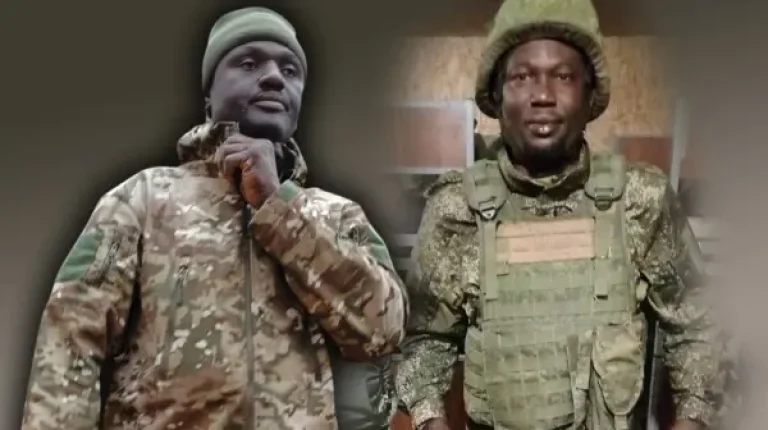
Reports say that at least 36 Nigerians were recruited to participate in Russia’s ongoing conflict against Ukraine, and five of them have been verified dead.
The new investigative investigation shows how young men who were vulnerable were led abroad with false promises of jobs and school, only to be coerced into military duty.
The investigative group All Eyes on Wagner produced a study in February 2026 called “The Business of Despair: The Russian Army’s Recruiting of African Fighters.”
After invading Ukraine in February 2022, Russia reportedly resorted to African countries to help boost its military, according to Sunday PUNCH.
The report, which is based on a database of 1,417 African recruits from 2023 to mid-2025 that Ukrainian sources provided, says that Nigerians are part of a larger plan to use foreign fighters as “cannon fodder” in high-risk assault operations.
The average age of African recruits is 31, and many of them come from poor families.
Abdoulaye Issaka Ismael, 27; Agbo Moses Omale, 43; Adamu Abdulai Ismail, 25; Mikael, 47; and Fajobi Taiwo Omoniyi, 50, are all confirmed dead in Nigeria.
The report indicated that the death toll of 316 African recruits might be higher because the list is not complete and more deaths were found through social media verification.
The OSINT Accountability Project’s study found networks that were recruiting African militants for Russia. These networks included travel businesses in both Russia and Africa that were touting “fast-track procedures.”
It was said that the agencies worked with recruiters in Russia who used social media and messaging apps, mostly Facebook, Instagram, Telegram, and TikTok, to reach potential recruits. They did this by posting videos and photos of life in Russia against the backdrop of Moscow skyscrapers or luxury cars, which are symbols of wealth, power, and success.
The OSINT study said that Nigeria is one of the countries that are being targeted, along with South Africa, Ghana, Kenya, Uganda, Cameroon, and Gambia.
It said that social media ads and travel firms that offered cheap flights and job prospects often tricked recruits into signing military contracts when they got there.
The report says that the offers are very appealing. They include signing incentives of several thousand dollars, base monthly incomes of $2,000 to $2,500 (more for “specialists”), health insurance, and even easier access to Russian citizenship after the contract is up.
It said that many of the promises are still not being kept, though, because fighters on the ground and those who were able to leave say they are not getting paid, their money is being taken by recruiters or superiors, or they are getting paid far less than what was promised.
Andrii Sybiha, Ukraine’s Foreign Minister, sounded the alarm in 2025 when he revealed that more than 1,400 people from 36 African countries were fighting for Russia, and many of them are now prisoners of war in Ukrainian camps.
Nigerians who got stuck in the trap
Families of Nigerians who were affected, especially those from southern states like Rivers and Ogun, were sad and angry.
A Nigerian man who was fighting for Russia and was arrested by Ukrainian forces told how he ended up joining the army.
In a video shared on X, the man said that his phone was taken away and he was forced to sign a contract in Russia without knowing what it said.
He thought he was being trained for a job in his field by taking a rigorous one-week course followed by another two-week program, only to be sent to the front lines right away.
He also talked about another Nigerian named Abubakar who had a heart-related problem while training and had to stay in the hospital for five days.
He added that when Abubakar got better, he realized he was being forced to join the military and refused to follow orders.
Even though he signed papers committing to a three-month jail term with the prospect of returning to Nigeria, he was nevertheless deployed to the front lines without sufficient training.
The Nigerian man stated he doesn’t know where Abubakar is right now.
A few days ago, Abubakar Adamu’s lawyers asked the federal government to step in quickly to help him get back to Nigeria from Russia. He said he was tricked into joining the army by being offered a civilian security post.
A publisher named Zagazola Makama said that Adamu’s lawyers told Nigerian officials that he went to Moscow on a tourist visa given by the Russian Embassy in Abuja on October 16, 2025, because he thought he would be working as a security guard.
When he got there, it is said that his travel documents were taken away and he was forced to sign recruitment paperwork printed in Russian without an interpreter.
He didn’t find out till later that he had joined the Russian army.
Adamu’s lawyers used the theory of Non Est Factum in a formal plea to Nigerian authorities, saying that he didn’t comprehend what the papers he had to sign meant or what they meant.
They further said that he was forced to join the military on false pretenses and that he was tricked into doing so.
The lawyers say that Adamu is currently in a Russian military camp and has refused to go to battle zones in Ukraine.
They told the Russian government to stop any deployment, give back his seized papers, and help him get back to Nigeria safely.
On Thursday, February 12, 2026, the Ukrainian Defense Ministry posted pictures of two Nigerians, Hamzat Kazeem Kolawole and Mbah Stephen Udoka, who were said to have died while fighting for Russia in Luhansk.
In August 2025, Kolawole signed a contract to join the Russian military. Udoka signed up on September 28 of the same year.
Both individuals had no military training and are said to have perished while trying to attack Ukrainian positions.
Recruiting center, rejections
St. Fortunes Travels and Logistics, a Port Harcourt, Rivers State-based firm run by Fortune Chimene Amaewhule, is said to be a major recruiting center in Nigeria.
The company was said to have publicly advertised joining the Russian army on social media and billboards, promising speedy perks including citizenship and big pay. It was founded in December 2022.
The agency was also reported to have given out contact details for people in Nigeria and Russia, and it was linked to ongoing advertisements that were aimed at job seekers.
Andrey Podyolyshev, the Russian Ambassador to Nigeria, said earlier this week that Moscow was not recruiting Nigerians to fight in the Russia–Ukraine conflict.
He claimed in Abuja that he didn’t know of any government-backed initiative to recruit Nigerians and that if such things were happening, Russia had nothing to do with them.
He said, “If anyone has this information, we are ready to send it to the Russian police so they can look into these cases.”
NIDCOM says that repatriation will be done by 2023.
In response, the federal government noted that its repatriation of Nigerians affected by the Russia–Ukraine conflict ended more than three years ago. It also said that those who stayed in Russia did so on purpose after giving up their Nigerian citizenship and joining the military.
Abdulrahman Balogun, a spokesperson for the Nigerians in Diaspora Commission, stated of Adamu’s case, “The federal government finished repatriation more than three years ago.” He joined the army on purpose, which means he must have given up his Nigerian identity.
The Ministry of Foreign Affairs did not reply to requests for comments on the report’s conclusions.
Alleged enlistment agency says Nigerians are greedy
Amaewhule also denied hiring Nigerians to fight as mercenaries in Russia in response to the claim against his company.
He added that his company had offered a trip package to Russia in the past, but they stopped doing so when he got what he called genuine evidence that some Nigerians were switching from valid work visas to join the Russian army when they got there.
Amaewhule said that recruiters lured potential recruits with money, saying they would get citizenship, a $30,000 signing bonus, and weekly payments of roughly $3,000.
“We had to stop because of that,” he remarked.
He said that the bundle his company supplied had nothing to do with the Russian military.
“It was for teaching, and that was even for Kazakhstan.” He remarked, “The two countries are very close, and there is a lot of need for English teachers there.”
Amaewhule also said that his company has not taken any clients directly to Russia other than Kazakhstan. He stressed that no one was hired before the package was put on hold.
He stated that around the time the company stopped the package, several clients asked for help working with the Russian army, but he said those requests were turned down.
The travel salesman also told the story of a client who used his company to go to Kazakhstan and then called him later to ask about joining the military.
Amaewhule says that the client, who he didn’t know personally and who was sent to him by a family acquaintance, sought the intermediary to talk to him about entering the army.
“I told the woman that we would never let anyone switch,” he said, adding that he asked the family to talk the man out of it.
Amaewhule also said that he learned more about the recruitment pipeline from another client whose family members had traveled from Qatar to Russia.
He said, “He helped me understand the process, how they were approached, and what was being offered.”
Amaewhule added that several Nigerians who went to Kazakhstan on student or work visas eventually crossed into Russia to join the military. This may have caused people to think that his company was involved.
About the Author