
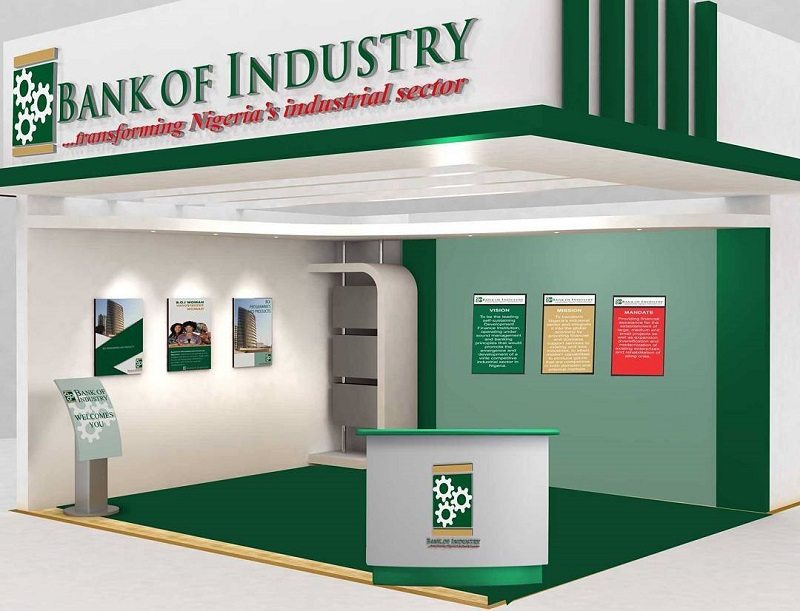
President Bola Tinubu is happy that the Bank of Industry (BoI) gave out N636 billion in loans to company owners in the Micro, Small, and Medium Enterprises (MSMEs) sector in 2025.
Mr. Bayo Onanuga, the Nigerian leader’s Special Adviser on Information and Strategy, said in a statement that the development proves his government’s plans for economic change.
Last year, the lender gave out soft loans worth N636 billion to more than 7,000 businesses, which was the most money the organization has ever lent in a year.
N202 billion went to agro-allied businesses, N100 billion to important national infrastructure like broadband, power, aviation, and transportation, N79 billion to manufacturing, N77 billion to extractive industries, and N55 billion to services.
The bank also used N73 billion in managed and matched funds for state governments and institutional partners.
The BoI 2025 payout featured strategic interventions like expanding a tomato processing facility from 3.1 metric tonnes per hour to 10 metric tonnes per hour and connecting 47,508 smallholder farmers to formal processing value chains.
The bank also helped put up 100 mini-grids with the help of global development finance organizations. These grids brought electricity to 11,777 new clients. Projects that were funded by BOI helped cut carbon emissions by an estimated 20,000 tons a year.
“The N636 billion that the Bank of Industry gave out in 2025 will directly increase Nigeria’s production potential. It helped thousands of businesses across our states by funding the growth of agro-processing, boosting manufacturing production, supporting infrastructure delivery, and giving them more power.
“During a time when money was hard to come by around the world, Nigeria made it easier for its businesses to get long-term capital.” “That is a direct result of reform, credibility, and institutional discipline,” Mr. Tinubu added.
It was noted that the way money was given out by business size shows a planned inclusion strategy. N51 billion went to nano businesses. Micro enterprises got N32 billion. Small and medium-sized businesses got N178 billion in loans, while large businesses got N375 billion.
As the disbursing institution for the federal government’s N200 billion MSMEs intervention program, BoI had a performance rate of over 95%. In 2025, the Presidential Conditional Grant Scheme helped 957,400 people.
Also, BOI’s lending efforts created and kept almost 1.6 million employment. The bank helped over 570 startups and more than 7,000 MSMEs this year.
There was also a meaningful effect from programs that provided inclusive financing. The Guaranteed Loans for Women Program, which gave up to N50 million to women-owned businesses, let women get more access to affordable financing. Businesses owned by young people got N12 billion in loans. The Rural Area Program on Investment for Development gave about N6.5 billion to 880 businesses in rural areas across the 36 states and the FCT.
The President also said that BOI’s asset quality stayed high, with a non-performing loan ratio of less than 1.5 percent even though the economy was not doing well. He also talked about the €2 billion syndicated facility that was set up in 2024 and the extra €210 million that was raised from overseas partners in 2025. These things made the Bank’s ability to lend stronger.
“Development funding needs to be controlled, measured, and in line with national goals. We are seeing the shift from strategy to scale.
“Our economic transformation will be based on production, adding value, and business growth.” President Tinubu said, “We will keep bringing in money, making institutional changes, and making sure that access to finance helps the real sector grow all over Nigeria.”
He said again that his government is committed to building on the progress made in reform and making it easier for businesses to get credit. This is part of a long-term plan to speed up industrialization and growth that benefits everyone.
About the Author