
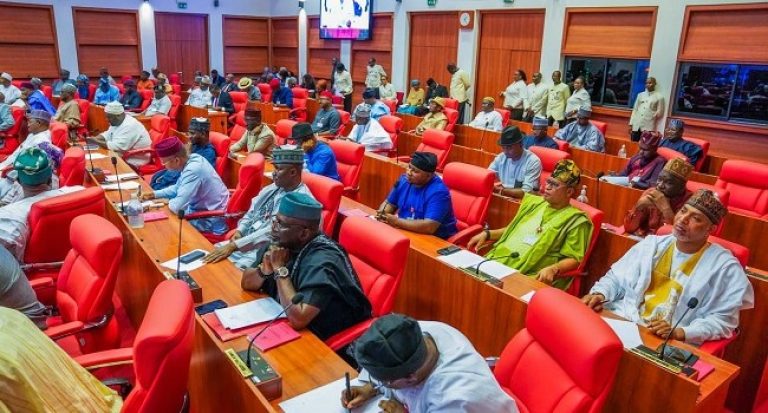
Hallowmace Foundation Africa, one of the leading groups working to promote democracy, good governance, and accountable legislation across the continent, has strongly condemned the Nigerian Senate’s passage of the retrogressive provisions in the Electoral Act 2022 (Repeal and Reenactment) Amendment Bill 2026.
The foundation’s Executive Director, Amb. Anderson Osiebe, and Head of Public Communication Desk, Amb. Oguh Hyginus John, signed a statement saying that the Senate’s actions are not a reform but a planned and systematic tearing down of the important guardrails that were put in place to protect the integrity, transparency, and credibility of Nigeria’s elections. This is nothing less than a violation of the democratic values of our country and a violation of the rights and dignity of every Nigerian citizen to vote.
It read, “We are condemning the following terrible reversals: The Rejection of Mandatory Electronic Transmission of Results (Clause 60) — The Senate preferred to keep things unclear by not requiring that polling unit results be sent to the INEC Results Viewing Portal (IReV) in real time.
“This choice deliberately undoes a key improvement in our democratic process and makes it possible for the most important part of an election—the counting of votes—to be manipulated and hidden. It is intolerable to give up the responsibility to make sure that every vote is tallied, seen, and protected.
“The Blocking of Technological Advancement in Voter Identification – The Senate’s rejection of electronically generated voter identification and its insistence on the Permanent Voter Card (PVC) as the sole mandatory form of identification, while upgrading to BVAS, is a contradictory move.
“It doesn’t take into account the real-world problems with PVC distribution and takes away people’s right to vote while not using technology that is already available to make the process more secure and open to everyone.
“Drastically Compressed and Unrealistic Election Timelines – Cutting the notice of election period from 360 to 180 days and the time for publishing candidate lists from 150 to 60 days will cause a lot of problems with logistics.
“These short deadlines will disenfranchise voters, hurt political parties, and put an impossible strain on the Independent National Electoral Commission (INEC), which will make mistakes, lead to lawsuits, and make the electoral process fundamentally faulty.
“Clause 142: Weakening of Legal Accountability — The clause that would have made it easier to prove election non-compliance in court has been removed. This is a bold attempt to protect electoral wrongdoing from quick and effective legal action. Saying it is a “waste of time” shows a startling lack of respect for fairness and accountability in elections.
The refusal to impose a strict 10-year prison sentence for buying and selling PVCs, instead keeping a short two-year sentence with a slightly higher fine, shows that the government is not serious about stopping the corruption and monetization of the voter franchise.
The organization went on to say, “We are very worried about the sharp and telling difference between the Senate’s backward position and the House of Representatives’ reportedly more forward-thinking position.”
“This difference shows a worrying disagreement at the heart of our legislature about the future of Nigerian democracy.
The Hallowmace Foundation Africa firmly supports the Nigerian people and all pro-democracy activists in their demand that the National Assembly Conference Committee must completely reject the Senate’s retrogressive sections when they are putting together the different versions of the bill.
“That the committee must bring back and reinforce the rules that require results to be sent electronically, set realistic and inclusive election dates, and make punishments for election crimes harsher.
“The final amended Electoral Act must be a tool for empowering the people, ensuring transparency, and guaranteeing that every vote cast in the 2027 general elections and beyond truly counts.”
“We ask that civil society groups, the media, the international community, and all well-meaning Nigerians speak out against this sabotage of the law.”
“We need to make sure that our MPs are held responsible for actions that hurt the democracy they promised to protect. The Senate’s vote on Wednesday, February 4, 2026, goes against what the people want, and it should not stand.
“The fight for a fair election process in Nigeria is not up for debate.”
About the Author