
Dangote Industries Limited (DIL) and the Nigerian National Petroleum Company Limited (NNPCL) have struck an improved gas supply arrangement that would make sure there is enough gas for Dangote Group’s continuing growth projects.
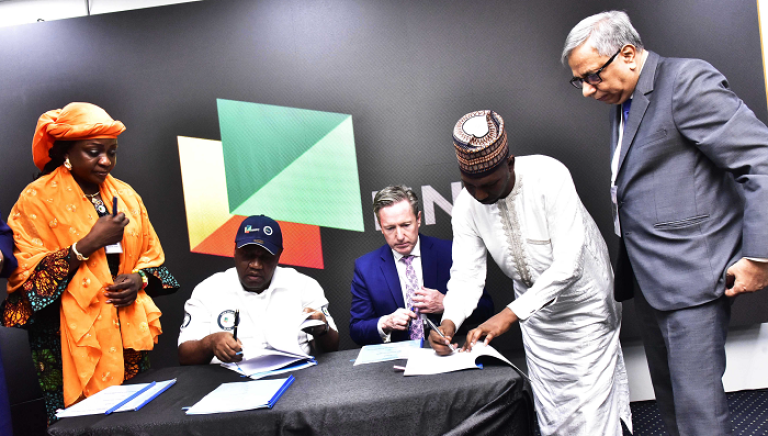
As part of the transaction, three DIL subsidiaries—Dangote Petroleum Refinery, Dangote Fertiliser Plant, and Dangote Cement Plc—increased their Gas Sales and Purchase Agreements (GSPA) with two NNPC subsidiaries—Nigerian Gas Marketing Limited and NNPC Gas Infrastructure Company Limited (NGIC).
The Nation says that the bigger supply arrangement should help Dangote Group’s Vision 2030, which means more production and a better and greener energy supply.
The NNPC Gas Master Plan (GMP) 2026, also known as NGMP 2026, was revealed at the NNPC Towers in Abuja over the weekend.
Mr. David Bird, the Managing Director of the Dangote Petroleum Refinery, signed for the refinery. Mr. Arvid Pathak, the Group Managing Director of Dangote Cement Plc, signed for the cement company. Mr. Mustapha Matawalle signed on behalf of Dangote Fertiliser FZE.
Bird stated that the deal showed that the refinery was willing to take big risks to grow its capacity.
He said that the agreements were a key step in the drive to expand and a way to make sure that the company would have enough electricity for the expected rise in its manufacturing capacity.
Pathak said that the arrangement would help DCP reach its strategic goals.
He said that the deal guarantees the gas needed to support the push for CNG adoption as auto gas and to fulfill the growing demand for gas as local production capacity grow.
He also said that the cooperation encourages the use of cleaner fuel for both vehicle gas (via CNG) and gas to help boost production.
Dangote Fertiliser FZE said that the deal would help its plans to increase its fertilizer production capacity because fertilizer is made from natural gas.
The Minister of State for Petroleum Resources (Gas), Rt. Hon. Ekperikpe Ekpo, said that the GMP Master Plan is a planned shift from making policies to carrying them out in a disciplined way, based on commercial viability and cooperation throughout the sector.
He stated, “The launch today is not just the release of a document; it is a deliberate move toward a gas sector that is more integrated, driven by business, and focused on execution, in line with Nigeria’s development goals.”
“Nigeria is a gas country at its core.” We have one of the greatest proven gas reserves in Africa, so our biggest difficulty has never been potential. Instead, it has been turning resources into reliable supply, infrastructure into value, and policy into demonstrable benefits for our economy and our people. The Gas Master Plan immediately addresses this problem.
Ekpo also said that the plan’s strong focus on making sure supplies are reliable, expanding infrastructure, being flexible in both domestic and export markets, and forming strategic partnerships fits perfectly with the Federal Government’s Decade of Gas Initiative. This makes natural gas the backbone of Nigeria’s energy security, industrialization, and just energy transition.
Bashir Ojulari, the GCEO of NNPC/L, called the NNPC Gas Master Plan 2026 a bold, effective execution-anchored blueprint that will unlock Nigeria’s huge gas potential and make the country a global gas hub.
Ojulari said that Nigeria has one of the most important hydrocarbon basins in the world, with about 210 trillion cubic feet (Tcf) of proven gas reserves and the potential for up to 600 Tcf more. The Petroleum Industry Act (PIA) and the Federal Government’s gas-centric energy transition agenda support this.
He said, “The Plan is set up not only to meet but also to exceed the President’s goal of increasing national gas production to 10 billion cubic feet per day by 2027 and 12 billion cubic feet per day by 2030, while also bringing in more than $60 billion in new investments across the oil and gas value chain by 2030.”
He said that the strategy puts cost optimization, operational excellence, and the systematic development of resources from 3P to bankable 2P reserves at the top of the list. It also strengthens gas delivery to power generation, CNG, LPG, Mini-LNG, and important industrial off-takers.
He emphasized his personal commitment as the initiative’s primary sponsor, underlining that the company has taken a more collaborative, investor-focused approach to crafting the NGMP 2026, with good alignment with industry stakeholders, partners, and investors.
About the Author