
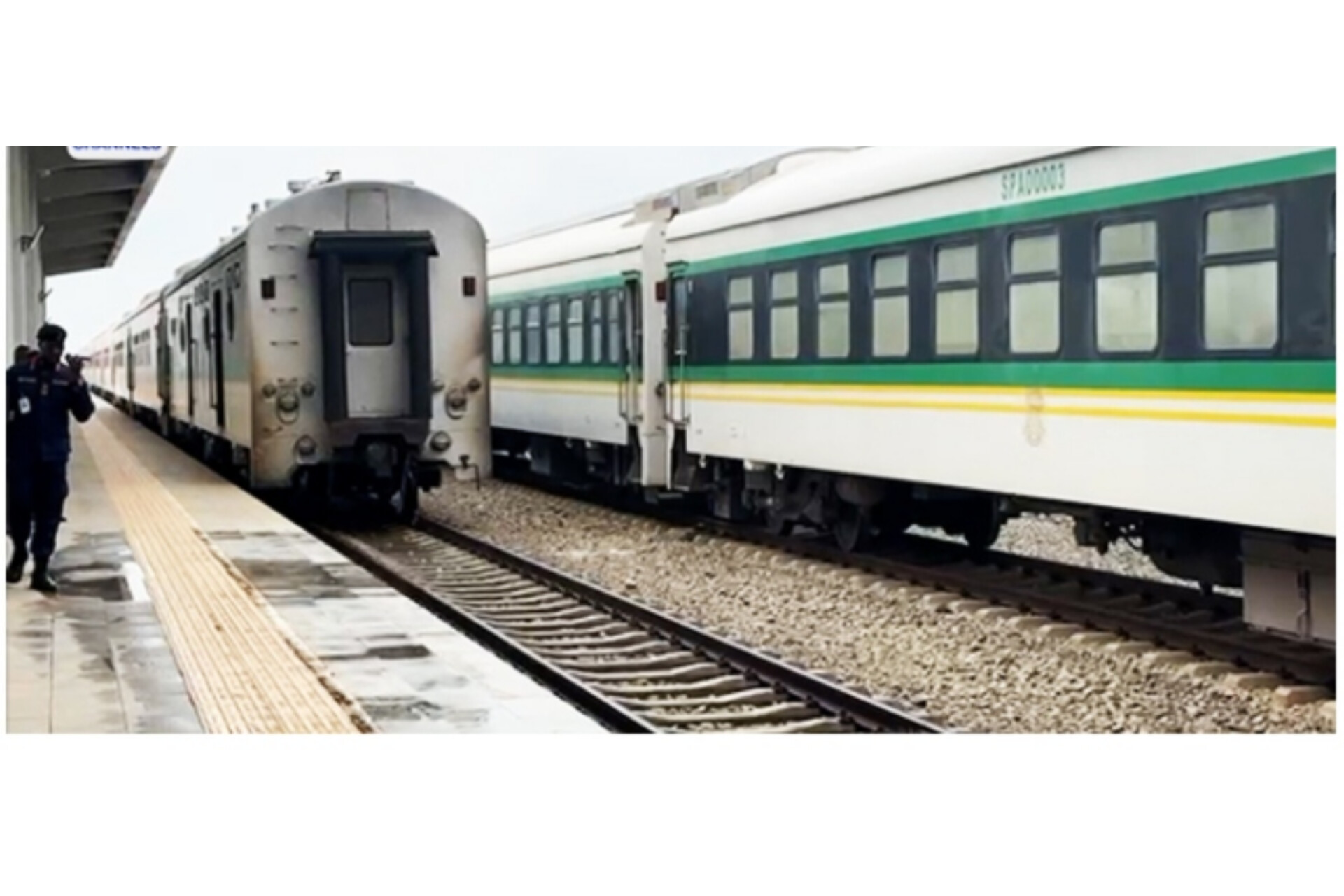
The Senate started a full investigation today into Nigeria’s railway system’s operational inefficiencies, lack of security, and potential financial wrongdoing. This comes as worries rise over diminishing service delivery on major train corridors.
The decision came after Senator Abdul Ningi made a motion during plenary and Senator Adamu Aliero made a point of order. Both senators brought the Senate’s attention to the worsening status of rail operations, especially on the Abuja–Kaduna–Kano line.
As a result, Senator Godswill Akpabio, the President of the Senate, set up an ad hoc committee led by Senator Adams Oshiomhole to look into the Nigerian railway system as a whole, according to The PUNCH.
Senators Enyinnaya Abaribe and Abdul Ningi are also on the committee, along with others.
The committee has been told to look at the execution of railway contracts, how money is spent, how well the system works, how well services are delivered, and how loans for train projects are used.
It is anticipated to turn in its findings in six weeks.
The investigation is likely to focus a lot on the billions of dollars in foreign loans used to build railroads and the quality of the infrastructure that was built.
The ad hoc committee was first set up in November 2025, but it has now been officially called into action to do a more thorough inquiry.
Aliero raised a point of order and said he was upset about how train services had gotten worse. He said that routes that used to have up to 10 trips a day now only have one.
“I call the minister almost every week and put the pressure on him,” he claimed. I told him, “This rail line is the pride of the country.” We can’t let it go down.
“All efforts must be made to make sure we get the train service back up and running between Abuja and Kaduna.”
Akpabio said he was very worried about the quality of Nigeria’s train services, especially the Abuja–Kaduna route. He said that journey times had gotten much longer and that the services were less efficient overall.
He said that the contract was given out while Umaru Yar’adua was president, sent out while Goodluck Jonathan was president, and started while Muhammadu Buhari was president.
“Actually, it was finished with a loan from China under Buhari. If you walk, you will go faster than the train in Lagos. If you walk quickly, you’ll even get to the one in Ibadan faster than the train and have to wait for the passengers inside. You can actually travel to Ibadan faster on a bike than the rail does.
“That’s a strange problem in Nigeria. People will remark about how someone is making money when they see them accomplish a wonderful job. But he does give services that work. He said, “We need to change how we think about work.”
Akpabio asked about the quality of the rail projects, saying that a well-built railway system shouldn’t need large repairs in the first few years of operation.
“If the rail system was built correctly, you wouldn’t need to make any repairs for at least five to seven years, or even ten years.” I think that majority of the coaches can’t fit on the rails because they are too small.
“When they turn, the whole coaches will fall because the old tracks were probably used in the 1960s and 1970s.” He said, “And so, the modern rail system is very sleek.”
The former governor of Akwa Ibom State also criticized the way the purchase was made and asked if the warranty terms were broken.
“So, I agree that the whole contract, both the money and the work, was a problem. If you obtain money from somewhere and say you want to fix something, what are you fixing? Is the warranty time over? The individuals who gave us those goods should tell us exactly how long they will last before they go bad.
“Even if things go wrong, they will fix it with their own money, not Nigerian money.” We are not trying to get back the money we lost, and we are not trying to figure out why they were second-hand.
“There’s no country that will just go out and buy used goods. I don’t believe this is true. So, whatever happened here had to be done by people. He said, “That’s why we have the ad hoc committee.”
Ningi said in his motion that the Abuja–Kaduna–Kano rail project was poorly done, even if it made a lot of money.
He said that even though the rail line has made more than ₦1.8 billion in revenue, the quality of service has not improved.
Ningi also said that the trip from Abuja to Kaduna used to take around an hour and a half, but today it takes about three and a half hours.
He also said that there is now only one train trip a day, with a departure from Abuja at 7:00 a.m. and a return trip from Kaduna, instead of the several trips that used to be available.
Ningi said, “I don’t want anyone to get the wrong idea about this.” First, I wanted to know if those cargoes were new when they were bought. No, the answer is no. They are used.
“What about the money they make? At least N1.70 billion?” That was what I meant by my action. Where is the cash? “People paid, not just for the service.”
In response, Akpabio restated the Senate’s constitutional duty to oversee, saying that the investigation was meant to hold people accountable and make things right.
He remarked, “The Nigerian constitution says that we have a duty to ask questions and look into these things to fix them.” We have always claimed that we are a parliament that fixes things. We need to look at these things and tell Nigeria what it did wrong.
“I think some people saved and kept the money for us to buy the used coaches.” Then we need to get them to return the money.
“We can get enough money back from that effort to fix the coaches we’re talking about or ask for a complete overhaul.”
Akpabio told Oshiomhole immediately to do a full probe.
“Well, Senator Adams Oshiomhole is here. We have put you in charge of a committee to look into this train problem. Look at the tracks, the coaches, and everything else. Why does it take three and a half hours to perform something that should only take 25 minutes?
“This shouldn’t take that long by today’s railway standards.” So, if you ride a bike, you’ll get to Kaduna before them. A Keke Napep can even go faster. Before the train arrives there, it will go to Kaduna and back to Abuja. “You have to do your work,” he said.
About the Author