
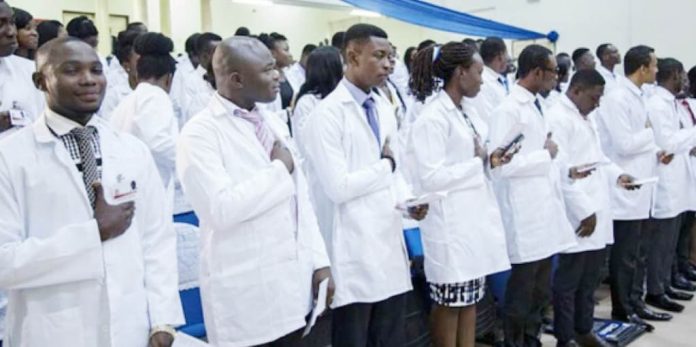
With only 40,000 licensed doctors, significantly fewer than the estimated 300,000 required to effectively serve a population of nearly 220 million, Nigeria’s already precarious healthcare system is seriously short-staffed.
According to Sunday PUNCH, Nigeria has roughly 55,000 licensed physicians in 2024, according to Prof. Muhammad Pate, Minister of Health and Social Welfare.
In an interview with Politics Today on Channels TV, Pate revealed that in the previous five years, at least 16,000 doctors had fled the nation and over 17,000 more had been transferred out of active duty.
Concerningly, according to a recent disclosure made by Prof. Akin Abayomi, the Lagos State Commissioner for Health, there are now only 40,000 active doctors in Nigeria, down from 55,000 a year ago.
One of the biggest issues facing the health sector, according to Abayomi’s presentation during a one-day leadership conversation in Lagos titled “Strengthening PHC Systems: A Joint Leadership Dialogue,” is a lack of people.
With assistance from development partners, the Lagos State Primary Health Care Board organized the discussion, which covered obstacles preventing PHCs from fulfilling expectations and offered workable ideas for creating long-lasting, sustainable PHCs.
Only 7,000 doctors presently serve an estimated 30 million citizens in Lagos, according to Abayomi, which is significantly less than the amount required for the best possible care delivery.
The commissioner expressed alarm about the severe lack of medical personnel in the state, revealing that an extra 33,000 physicians are needed to address the state’s expanding healthcare needs.
“Lagos alone needs about 33,000 doctors but has only about 7,000, while Nigeria currently has about 40,000 doctors against an estimated need of 300,000,” he stated.
He claims that the doctor-to-population ratio in Lagos is still well below what is needed for the best possible healthcare delivery, pointing out that the state’s physicians treat an estimated 30 million residents.
According to Abayomi, the state government is making investments in the recently founded University of Medicine and Health in order to make up the difference.
He said, “UMH will produce about 2,500 healthcare workers annually within five years, including laboratory scientists and other essential cadres.”
The widespread departure of medical personnel, commonly referred to as “Japanese syndrome,” particularly physicians, nurses, and pharmacists, has continued to be a significant issue in Nigeria.
Approximately 88% of Nigerian doctors were looking for work overseas at the time, according to a 2017 survey done by a Nigerian polling organization in collaboration with Nigeria Health Watch.
Poor funding, deteriorating infrastructure, unfavorable working conditions, insecurity, and inadequate policy execution have all been blamed by healthcare officials for the growing brain drain.
The General Medical Council of the United Kingdom reports that 11,001 doctors with Nigerian training are now working in the country.
Nigeria has gone beyond passive brain drain and has turned into a direct recruitment center for foreign governments looking for qualified medical professionals, according to a recent warning from Prof. Bala Audu, president of the Nigerian Medical Association.
In an exclusive interview with our correspondent, Audu disclosed that foreign recruiters now travel to Nigeria to directly hire doctors, especially specialists like obstetricians, gynecologists, and pediatricians, offering them better infrastructure, pay, and working conditions.
He bemoaned the fact that Nigeria is losing experts at a startling rate despite the country’s population growth and high death rates.
“A large number of our physicians are not even traveling overseas in search of employment. These days, foreign governments travel to Nigeria to select and remove doctors, according to Audu.
“We are still having more births, but the number of skilled birth attendants who should care for these women is decreasing daily, so maternal deaths are still high.”
According to Audu, there may already be more Nigerian doctors working overseas in some specializations than there are in the nation, and this scenario is made worse by the government’s inability to considerably enhance doctors’ welfare in spite of current legislative frameworks.
Experts have cautioned that Nigeria cannot create enough healthcare workers to meet its expanding healthcare demands at the current rate of emigration. They calculate that training the more than 400,000 health personnel needed to narrow the gap would take at least 20 years.
Prof. Mike Ogirima, a former NMA president, called Nigeria’s doctor-to-patient ratio “horrible,” pointing out that the country now has roughly one doctor for every 8,000 patients, which is far less than the World Health Organization’s recommended ratio of one doctor for every 600 patients.
According to Ogirima, who previously spoke with our correspondent, Nigeria generates an average of just 3,000 doctors per year, making it challenging to fill the estimated shortage of about 300,000 doctors.
He stated, “It will take at least ten years to catch up if we are producing just 3,000 doctors annually—and that is assuming no doctor leaves the system.”
“We can’t afford to hold out that long. Doctors are overworked, worn out, and burned out as a result.
Ogirima warned that without sufficient motivation and assistance, retention will continue to be challenging and encouraged the government to prioritize funding for health workers’ training, enhance security, and supply contemporary equipment.
Physicians have persisted in demanding immediate changes to save Nigeria’s faltering healthcare system, emphasizing the need of a protected and driven medical personnel for the country’s progress.
As part of a larger welfare and retention strategy, they also asked the federal and state governments to enroll doctors in comprehensive insurance plans right away, cautioning that the issue would worsen if nothing was done.
About the Author