

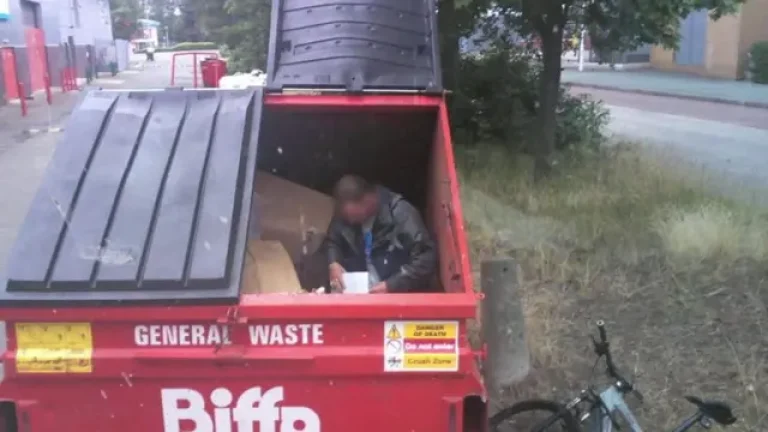
To avoid deportation, a number of undocumented Nigerians and other Africans living in the UK have been sleeping in trash cans on the streets.
The UK government launched the “Plan for Change,” a significant revamp of immigration laws, in 2025.
As individuals without legal status were deported in the middle of 2025, the strategy caused a wave of terror among migrants, according to Saturday PUNCH.
43 criminals and asylum seekers were sent back to Ghana and Nigeria on a charter airplane, according to the Home Office.
According to the Home Office, “those removed had no right to be in the UK, including 11 foreign national offenders who had served their sentences and 15 unsuccessful asylum seekers.”
The British government also said that it would keep tightening immigration laws in an effort to boost border security, lower net migration, and reorient legal immigration toward contributions and skills.
Later, an African man was seen sleeping in a bin on a snowy street in the UK in a widely shared video that Diaspora Tales was able to secure.
He was asked to go and use a shelter that the UK government had given by a European man.
Speaking to Diaspora Tales, Nigerians in the UK responded to the film by saying that many illegal migrants had been compelled to leave their homes and sleep on the streets out of fear of being discovered, arrested, and deported.
Homelessness and crime
According to Mrs. Gisela Esapa of Dunstable County, a large number of migrants who sleep in dumpsters and on the streets are typically homeless people who are involved in criminal activity.
Nigerians and other migrants are not the only people who sleep on the streets, according to Esapa, who also mentioned that Brits and other Europeans in the UK are affected.
She mentioned that some Nigerians who entered the UK illegally ended themselves homeless and jobless.
The Nigerian woman claimed that drug users and mentally ill people frequently converted the streets into residences.
“I saw many people, including Nigerians and Brits, who slept on the streets when I was living in Luton because they lacked documents like a Biometric Residence Permit,” she stated.
“I saw the behavior of the many immigrants that resided in Luton. Some people were terrified to even enter UK government-run facilities for fear of being apprehended, arrested, and deported.
Many homeless immigrants were sleeping at train stations, according to another Nigerian in London who spoke on condition of anonymity.
In order to avoid deportation, the insider continued, illegal migrants would do everything, even sleep on the streets.
“Black people are not all homeless.”
Maxwell Adeyemi, a Nigerian living in Bradford, said our correspondent that nationality or race had no bearing on homelessness in the UK.
He clarified that a number of circumstances, including unemployment, a lack of documentation, and criminal activity, were typical causes of homelessness.
“I don’t know if Nigerians are homeless right now, but the majority of homeless people are Asians and white people from Eastern Europe, not even black people,” Adeyemi explained.
Crimes have repercussions.
Speaking on the subject, the Nigerians in Diaspora Commission stated that many Nigerians who are homeless in the UK are merely dealing with the fallout from their misdeeds.
Abdur-Rahman Balogun, the Director of Media, Public Relations, and Protocol for NIDCOM, said that after migrants had overstayed their visas and refused to return to Nigeria, they will begin to dodge immigration officials.
“They are only dealing with the fallout from their offenses, which are typically overstaying their visas,” Balogun stated.
He continued by saying that NIDCOM was not aware of any recent instances of Nigerians sleeping on UK streets.
“Only when the governments that host Nigerians include us in the deportation of the illegal migrants do we receive deportees,” he continued.
Help is drawn to documentation.
According to Diaspora Tales, the UK government is only deporting immigrants who lack legal status, ensuring that even those who are legally destitute can get assistance.
Local councils that offer short-term lodging options like hostels and shelters typically provide this kind of support.
There are places for homeless people to sleep, and some of them also serve meals. The fact that people who are legally residents of the UK always receive assistance, however, is what matters most,” Esapa continued.
About the Author