
In 2025, Nigeria’s cotton, textile, and garment (CTG) sector was still under a lot of stress. Stakeholders warned that without quick, coordinated, and long-term changes, one of the country’s most job-rich industries could continue to decline, even though it has been shown to help industrialization, save foreign exchange, and support livelihoods.
In separate interviews with our correspondent, stakeholders said that Nigeria’s problems with cotton and textiles are not caused by farmers being inefficient, but by inconsistent policies, weak market protection, and not enough money for production.
According to Daily Independent, they said that the best way to solve the problem is to invest in domestic production systems that reward farmers, promote industry, and ensure the country’s industrial future, rather than relying on emergency imports.
The specialists in the field also indicated that the problems in the sector are not new; they have been getting worse because of ongoing structural deficiencies, inconsistent policies, and the end of important interventions.
Ado Sule, the Director of Administration for the National Cotton Association of Nigeria (NACOTAN), said that one of the biggest problems in the sector is that there aren’t enough high-yielding hybrid cotton seeds that are appropriate to the area.
He says that this has led to low farm productivity and high production costs, which means that Nigerian cotton yields are well below global standards and are becoming less competitive.
He noted that prior interventions highlighted the sector’s potential. For example, the Central Bank of Nigeria’s Anchor Borrowers’ Programme (ABP) led to a big increase in seed cotton production, which brought back roughly 26 ginneries and got parts of the textile value chain going again.
However, when the program ended, there was no long-term plan for the transition, which caused output to drop sharply.
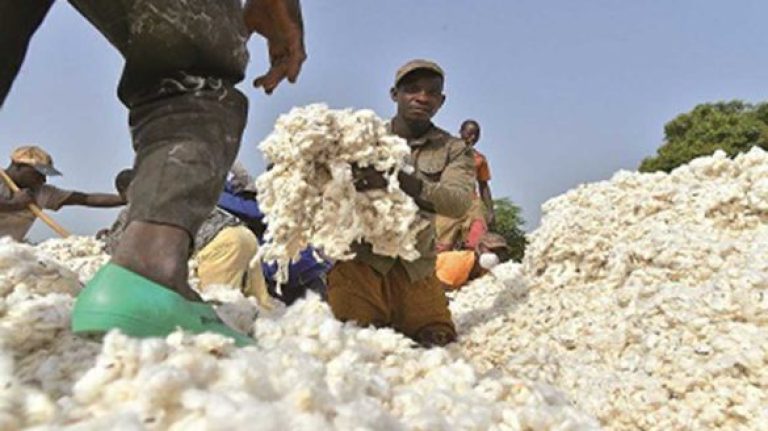
By the 2023/2024 season, national seed cotton production had decreased to an anticipated 15,000 metric tons. For the 2024/2025 season, it was expected that production would not surpass 20,000 metric tons. These numbers are substantially below what is needed to keep ginneries and textile mills working sustainably.
Sule found that there are deep-seated structural problems along the CTG value chain, such as low funding for cotton seed research, high costs for imported machinery and spare parts, limited access to affordable long-term financing, and the lack of internationally recognized High Volume Instrument (HVI) testing facilities.
He claimed that because of the unavailability of these kinds of facilities, Nigerian lint is sold at a lower price in export markets.
He also said that problems with the power supply, high operational costs, and the ongoing smuggling and dumping of textile goods were all hurting local production.
Sule urged for a coordinated, long-term plan to bring back confidence and growth in order to stop the downturn.
He suggested that research institutes, especially the Institute for Agricultural Research (IAR) in Zaria, get long-term funding to create competitive cotton varieties. He also suggested that the government give incentives to start a domestic cotton seed industry and that agencies like the National Agricultural Land Development Authority (NALDA) prepare and clear large areas of land to support mechanized farming.
Other ideas included helping smallholder farmers buy machines, getting rid of tariffs on ginning and textile machinery, setting up HVI labs, giving single-digit, long-term financing across the CTG value chain, and making a private-sector-driven CTG Board to coordinate policy and align fiscal and monetary interventions.
Samuel Oloruntoba, Secretary of the Cotton Farmers Association of Nigeria, said that 2025 would be another year of decline in the ginning sub-sector.
He claimed that the sector didn’t get any better because some textile companies that were still in business before 2025 went out of business, while others were sold. He also said that ginneries had similar results.
Oloruntoba says that the few ginneries that are still open are only operating at less than 20% of their full capacity since there isn’t enough cotton being grown.
He also said that more than 80% of Nigeria’s cotton is sent to other countries. Exporters face problems that may have been avoided if local textile mills were working.
He said that the industry could die out if nothing is done, and he stressed that any action must be comprehensive and include cotton farming, processing, textile manufacture, and garment production all at once.
Oloruntoba pushed for a 10-year growth plan to bring the sector back to life. He also pushed for the creation of the Cotton, Textile and Garment Board (CTGB), which the National Economic Council approved last year.
He suggested that if the board were fully active, it might assist solve many of the sector’s problems.
He also stressed that all stakeholders, such as the federal and state governments, research institutes, organized private sector groups, agro-commodity associations, and cooperatives, must be involved in future agricultural and textile interventions to make sure they work together to achieve success.
He thought that steady expansion in staple crops may help keep food costs stable and give industries cheap raw materials.
He also called for more mechanization across the country, better subsidies for farm inputs like fertilizers and high-yielding seeds (especially for cotton farmers), huge investments in irrigation infrastructure to lessen the effects of climate change, and coordinated efforts to deal with the insecurity that affects farming communities.
He saw chances in the newly approved CTGB and said that if it was put into action correctly, it might bring cotton production back to life, revive textile mills that were on the verge of closing, and boost growth in the garment sector, which would create a lot of jobs and boost GDP.
Anibe Achimugu, the president of the National Cotton Association of Nigeria (NACOTAN), said that 2025 would be a year of stable but still below-potential performance.
He said that the sector was strong even though the economy and security were bad. He pointed out that agriculture was still a major part of the economy, making up at least 30% of GDP in the third quarter of 2025, even though the overall economy grew by more than three percent year on year.
Achimugu highlighted that agriculture cannot be disregarded and asked for planned, cooperative actions to make sure the sector always does better than expected.
He noticed that the government is moving away from making comments and toward building systems, mechanization, organized input delivery, better data integrity for farmers, and better coordination with states and development partners.
But he warned that we shouldn’t forget about the need for smallholder farmers to be involved with commodities groups on purpose.
He also talked about how important it is to connect cash crops like cotton to food security. He suggested intercropping approaches that help rural people make a living by giving them access to food staples and cash revenue.
He says that food security is really about how strong a household is.
Achimugu said that the CTG Development Board’s full formation and effective execution of its mandate would make sure that the cotton, textile, and garment value chain was properly coordinated, from getting quality seed and extension services to offtake, ginning, and mill revival.
He claimed this will create jobs and wealth, lower imports, boost rural incomes, and help achieve goals for equitable growth.
About the Author