
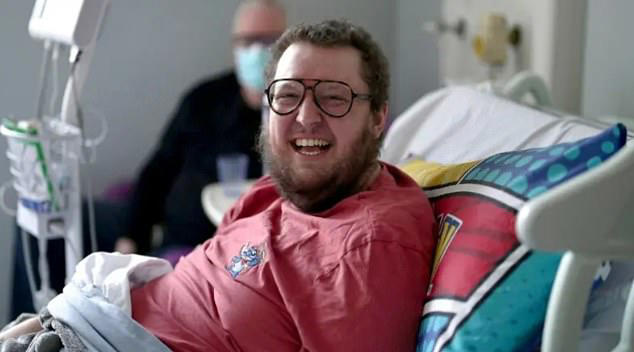
After a novel new medication was approved for use against his type of leukemia, a man with a common form of the disease became the first patient to get it on the NHS.
The ‘living medication’, which is derived from a genetically altered version of his own immune cells, was administered to Oscar Murphy, 28, who called it ‘fantastic… very sci-fi’.
The procedure, known as CAR-T therapy or “obe-cel,” entails reprogramming a patient’s immune cells in a laboratory to recognize and target a particular form of cancer before releasing them back into the body as “living medicine.”
Mr. Murphy has B-cell ALL (Acute Lymphoblastic Leukemia), a rapidly progressing blood cancer in which the bone marrow overproduces immature B-cells (blasts) that are unable to fight infection, pushing away good cells.
The most prevalent kind of ALL is B-cell ALL, which frequently manifests as fatigue, recurrent infections, and easy bruising. Children are diagnosed with it most frequently.
Mr. Murphy was the first patient to get CAR-T therapy outside of a clinical study. The treatment has been offered on the NHS for a number of years for specific forms of leukemia and lymphoma, but it has only just been expanded to adults with B-cell ALL.
The medication was initially given to Mr. Murphy at Manchester Royal on January 2. He received his second and last dose on Monday at the Infirmary, one of the specialized facilities chosen by NHS England executives to deliver the treatment.
Intravenous CAR-T treatment is administered to eligible patients twice, separated by ten days.
Oscar Murphy, age 28, was the first B-cell ALL patient to get CAR-T treatment.
The procedure, which one manager referred to as “hope for a cure,” is expected to assist about 50 people annually.
In a clinical trial, half of the patients showed no indications of cancer after three and a half years, and 77% of patients experienced remission following treatment.
Additionally, patients received an extra 15.6 months of life on average as a result of the treatment.
The treatment’s impact on ALL was previously praised by Professor Peter Johnson, NHS National Clinical Director for Cancer, who stated: “This innovative therapy has demonstrated genuine promise in trials and could give patients with this aggressive form of leukemia a chance to live free from cancer for longer – and, for some, it could offer the hope of a cure.”
After receiving a B-cell ALL diagnosis in March 2025, Mr. Murphy received chemotherapy and a donor stem cell transplant in July.
But the Bury car dealer was informed in November that his cancer had returned.
“My leukemia is so fast-acting,” he remarked. To halt it, an even faster reaction is required. And we now have a response to that. Although it’s really science fiction, it’s amazing if it means that my own cells can eradicate the cancer permanently.
T cells, a subset of white blood cells that are a component of the body’s immune system, were extracted from Mr. Murphy last month and sent to a laboratory in Stevenage.
After that, a harmless virus was used to splice the cells, and they were reprogrammed with a genetic sequence that enables them to recognize and attach to cancer.
The new cells are technically known as “chimeric antigen receptor T-cells,” or CAR-T-cells, and millions of them are produced in lab settings by researchers.
The CAR-T cells eliminate the malignancy they were designed to target after being reintroduced into the body.
Following the cultivation of 100 million of Mr. Murphy’s CAR-T cells, the living medication was frozen and supplied to Manchester doctors in the form of a mere three teaspoons of liquid.
Once they were ready, it just took a few minutes for them to enter his bloodstream and start working.
After receiving approval from the National Institute for Health and Care Excellence, the medication will be made available to individuals aged 26 and older who have B-cell ALL that has returned or not responded to prior treatment.
In order to receive treatment, patients from Wales and Northern Ireland will have to go to England. Scotland has not yet given it approval.
“This type of leukemia is usually very aggressive and adult patients don’t live beyond six to eight months,” stated Dr. Eleni Tholouli, Mr. Murphy’s haematologist. We can give them years and even a cure with this therapy. It’s extremely important and is changing how we treat cancer.
Culled from The Daily Mail, UK
About the Author