
According to an examination of appropriation bills from 2024 to 2026, the federal government has set aside a total of N10.61 billion for the three-year engine refurbishment of the Gulfstream G550 aircraft assigned to Vice President Kashim Shettima.
The aircraft, registered as 5N-FGW, accounted for 55% of the N19.27 billion spent on engine maintenance throughout the fleet under President Bola Tinubu’s administration, making it the aircraft with the largest single allocation among all engine refurbishment projects in the Presidential Air Fleet.
According to budget records that The PUNCH was able to access and analyze, the amount allotted for the vice president’s aircraft engine overhaul increased by 345 percent from N1.24 billion in 2024 to N5.51 billion in 2025 before leveling out at N3.86 billion in 2026.
The project was designated as “Overhaul of 5N-FGW Engines” under code ERGP31206170 in the 2024 Appropriations Bill, with a N1.24 billion budget and a “NEW” status. The project’s status was moved to “ONGOING” by 2025, and the allocation increased to N5.51 billion. However, in 2026, it decreased to N3.86 billion while keeping its “ONGOING” classification.
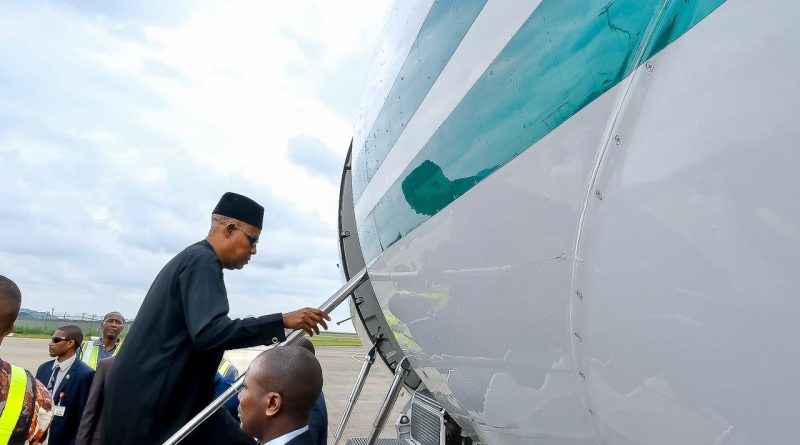
Shettima’s previous international travels have been canceled due to technical issues with the 13-year-old Gulfstream G550, which is flown under the call sign “Nigerian Air Force 2” when transporting the vice president.
Shettima’s journey to the US for the 2024 US-Africa Business Summit in Dallas, Texas, had to be canceled in May 2024 due to an aircraft malfunction that occurred mid-flight.
The incident happened less than a month after the identical Gulfstream jet that was first allocated to the vice president experienced an oxygen leak in the Netherlands, forcing President Tinubu to charter a private jet to Saudi Arabia. After a foreign object struck the plane during a stopover at JFK Airport in New York, the vice president once more canceled his trip to Samoa for the Commonwealth Heads of Government Summit in October 2024.
According to administration officials who talked to our correspondent under condition of anonymity, the frequent technical malfunctions might have led to the need for urgent maintenance, which in turn caused the budgetary allocations to increase.
The FG also provided funding for the overhaul of the engines on two Falcon 7X jets (marked 5N-FGV and 5N-FGU) in addition to the vice president’s aircraft. These aircraft received N1.66 billion in 2024, N3.13 billion in 2025, and N2.19 billion in 2026, for a total of N6.98 billion over the three years. Furthermore, in 2024, a Gulfstream jet registration 5N-FGS was given N1.68 billion for an engine overhaul; however, no additional funding was provided for it in the following years.
The Presidential Air Fleet’s engine overhaul projects cost N4.58 billion in 2024, N8.65 billion in 2025, and N6.05 billion in 2026, for a total of N19.27 billion across the three years.
Engine maintenance costs peaked in 2025, a year after the Presidency received the N150 billion Airbus A330, which the president’s spokesperson, Bayo Onanuga, claimed would “save Nigeria huge maintenance and fuel costs, running into millions of dollars yearly,” according to a close examination of the allocation patterns.
Routine aviation maintenance funding under line item 22020407 grew by 10%, from N4.12 billion in 2025 to N4.54 billion in 2026, but engine overhaul spending for older aircraft decreased by 30% in 2026 compared to 2025.
“These planes are not brand-new. The cost of operation and maintenance increases with aircraft age. Therefore, the price would rise over time, according to Olumide Ohunayo, General Secretary of the Aviation Round Table. He maintained that as vital parts, including engines, near the end of their useful lives, the 13-year-old Gulfstream G550 needs more regular and costly overhauls.
John Ojikutu, the CEO of Centurion Security Limited, said, “The figure probably includes far more than the direct cost of repairing the aircraft.”
According to an airplane maintenance engineer who wished to remain anonymous, “engine overhauls are mandatory at specified intervals, regardless of whether the aircraft has been flown extensively or not.” Depending on the condition and amount of work needed, a full engine overhaul for a jet like the G550 can cost anywhere from $1.5 million to $3 million per engine. The cost increase may indicate that they are replacing important parts rather than only performing routine inspections. It can also indicate that they need to undertake catch-up work because they put off earlier maintenance.
Currently operating ten aircraft, including six fixed-wing planes and four helicopters, the Nigerian Air Force’s Presidential Air Fleet is based at the Presidential Wing of Nnamdi Azikiwe International Airport in Abuja.
Nigeria’s presidential fleet is among the biggest in Africa, according to critics, and it is excessively costly for a nation facing dire financial difficulties.
Debo Adeniran, the Executive Chairman of the Center for Anti-Corruption and Open Leadership, contended that the administration’s spending patterns went against Nigerians’ expectations of thrift.
“This administration is giving us the exact opposite of what we expected. We anticipated an administration that would be extremely careful with its budget and prudent with its expenditures. “What we are getting, however, is an administration that has fallen in love with wastefulness and doesn’t see anything wrong with living large in the middle of a country that is impoverished,” Adeniran described.
Citing high maintenance costs and safety issues with the aging fleet, the House of Representatives Committee on National Security and Intelligence had advised in 2024 that the president and vice president should each have new aircraft. The vice president’s plane, which has received significant maintenance funding under Tinubu, did not receive a comparable replacement, despite the president receiving an Airbus A330.
Questions concerning the specifics of the engine work performed on the aircraft were not answered by the Presidency at the time this report was filed.
Current capital projects for PAF infrastructure are also listed in the budget records. For example, N714.8 million was allocated in 2025 to build a hangar for the Presidential Air Fleet, but that amount dropped to N500.36 million in 2026.
Due mostly to lower capital expenditures, the PAF’s overall budget allocation reduced from N17.32 billion in 2025 to N14.70 billion in 2026.
About the Author