
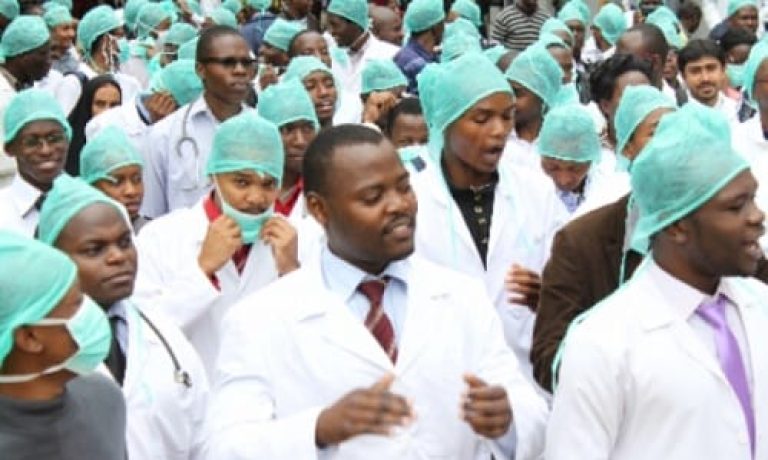
The Nigerian Association of Resident Doctors (NARD) has told its members who work at 91 tertiary health institutions across the country to stop working altogether and for an unknown amount of time starting at 12:00 am (midnight) on Monday, January 12, 2026.
The Guardian says that the order was made because the federal government didn’t follow through on the Memorandum of Understanding (MoU) it signed with the association.
Dr. Adekunle Salako, the Minister of State for Health and Social Welfare, said that the association’s demands had gone down from 19 to 9. NARD disagreed with this.
The association says that the cut was only for communication with the public.
NARD said, “But if you x-ray those nine, they are really 16 items.”
The association also disagreed with the Federal Ministry of Health and Social Welfare’s decision to move five resident doctors who had left the Federal Teaching Hospital (FTH) in Lokoja to another federal teaching hospital. They insisted that the doctors be immediately and unconditionally reinstated at FTH Lokoja, as recommended by a properly formed committee.
Dr. Mohammad Usman Suleiman, President of NARD, told reporters in Abuja yesterday that the association’s Extraordinary National Executive Council (E-NEC) held an emergency meeting on Friday, January 2, 2026, to talk about how well the MoU with the Federal Ministry of Health and Social Welfare (FMoH&SW) and the Federal Ministry of Labour and Employment (FMoL&E) was being carried out.
He noted that the MoU came about because of NARD’s 19 requests, which deal with important issues of pay, welfare, and professional practice that affect resident doctors all throughout the country.
Suleiman claimed that the process for making a collective bargaining agreement was still stuck and asked President Bola Ahmed Tinubu to step in.
He remarked, “The process of collective bargaining is still on hold and needs to start up again right away and end on time.”
He was worried about something the Minister of State for Health said on a TV show, where he said that the process of collective bargaining had been put on hold.
Suleiman said that the ministry was using delay tactics to stop resident doctors from discussing their pay with the government for the upcoming year.
He promised that NARD would start the Total, Comprehensive, and Indefinite strike again, which had been put on hold, unless the federal government and the state governments involved show “clear, concrete, and genuine commitment” to meeting the association’s demands.
The president of NARD was quite worried about how long it was taking for the Budget Office and the Federal Ministry of Finance to process and pay the promotion arrears owing to doctors at many institutions.
He also didn’t like how long it took to send salary arrears owing to doctors in some places for the same processing.
Suleiman said that the Integrated Personnel and Payroll Information System (IPPIS) had not yet settled the issue of reconciling and paying all the missed payments and omissions related to the arrears from the 25 percent and 35 percent increase in CONMESS and accoutrement allowance, which affected about 40 percent of members.
He asked for all unpaid House Officers’ salaries to be paid right now, as well as fast salary payments and a formal pay advice to House Officers, as the Medical and Dental Council of Nigeria (MDCN) had promised.
Suleiman also wanted the MDCN to quickly change the categories of membership certificates back to their original forms and the National Postgraduate Medical College of Nigeria (NPMCN) to quickly issue credentials after Part I exams.
He also asked for the prompt payment of all unpaid salaries and allowances owing to doctors in impacted federal and state tertiary health institutions, such as BSUTH, KSSH, DELSUTH, FMC Owo, UUTH, OAUTHC, UITH, and FUHSTH Otukpo, among others.
Suleiman underlined the need for the government to step in quickly and proactively to fix the crumbling infrastructure and replace outdated equipment in health institutions around the country.
He stressed the need for faster and more measurable progress on all other outstanding demands that had already been agreed upon with the federal government. He pointed out that the full implementation of the approved Professional Allowance Table, including the payment of back pay, had not been fully carried out and should be properly reflected in the 2026 national budget.
About the Author