
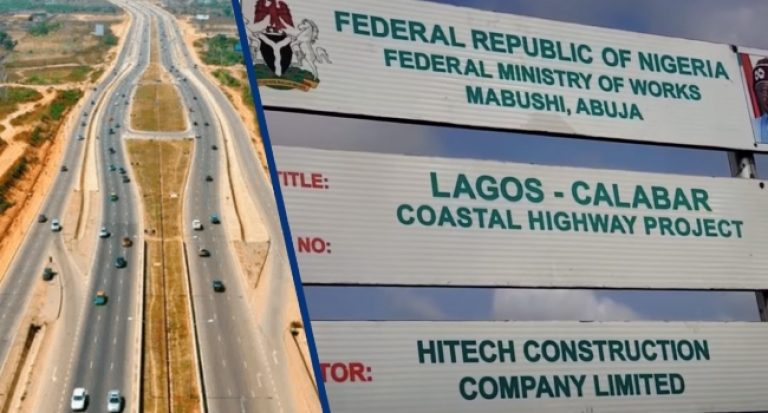
The $1.26 billion funding agreement for Phase 1, Section 2 of the Lagos–Calabar Coastal Highway was successfully closed, and President Bola Tinubu praised the accomplishment, calling it a significant step forward for Nigeria’s infrastructure development.
The Federal Ministry of Finance, the Ministry of Works, and the Debt Management Office worked together to get the cash, and the President was impressed, according to a statement released yesterday by presidential spokesperson Bayo Onanuga.
Onanuga emphasized the road’s revolutionary potential while pointing out that the milestone would guarantee continuous project progress.
One of President Bola Tinubu’s greatest presents to Nigeria is the Lagos–Calabar Coastal Highway. When the Tinubu administration finishes the road, those who have criticized this historic initiative would be embarrassed of themselves, according to Onanuga.
Tinubu emphasized that the highway continues to be a key component of the government’s infrastructure and economic program and said the financial milestone showed his administration’s dedication to investigating creative funding solutions for important national projects. The project’s Phase 1, Section 2 connects Ode-Omi and Eleko in Lekki over a distance of roughly 55.7 kilometers.
Closing this deal will allow the Lagos–Calabar Coastal Highway to continue uninterrupted, which is a significant accomplishment.
“To carry out important economic and priority infrastructure projects nationwide, our administration will keep looking into available funding opportunities,” the president stated.
The highway’s Phase 1, Section 2 spans approximately 55.7 kilometers and connects Eleko in Lekki with Ode-Omi, two important economic corridors that are anticipated to improve the effectiveness of national commerce and logistical linkage.
The funding comes after $747 million was already obtained for Phase 1, Section 1, demonstrating the project’s scalability and appeal to global investors.
First Abu Dhabi Bank and Afreximbank provided full underwriting for the loan, while the Islamic Corporation for the Insurance of Investment and Export Credit (ICIEC) provided some risk reduction assistance.
Growing investor confidence in Nigeria’s improved investment climate is reflected in this transaction, which is ICIEC’s biggest since the country’s institutional and regulatory reforms.
About the Author