
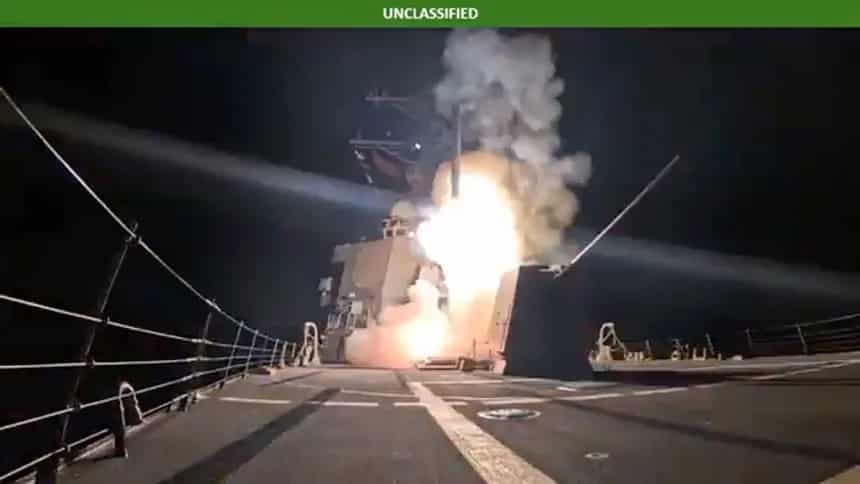
Intense public debate has been sparked by recent accusations that the United States carried out an airstrike on terrorists linked with Islamic State (IS) in Nigeria, especially after allegations that the group was preparing assaults against Christian villages.
According to The Guardian, the Director General of the Human Rights Writers Association of Nigeria (HURIWA) responded to the development by calling the strike a legitimate and long-overdue response to years of unchecked terrorism that has killed thousands of innocent people of all religious and ethnic backgrounds.
The rights activist claims that millions of law-abiding, patriotic, and peaceful Nigerians have applauded the move, viewing it as an essential response to terrorist organizations that have outgrown Nigeria’s security capabilities.
He emphasized that Christians have not been the only targets of the violence, but that Christian communities have suffered a terrible proportion of the attacks.
Worshippers, Pentecostal pastors, and Catholic priests have all been singled out and assassinated on several occasions. Communities in the Plateau, Benue, Southern Kaduna, Taraba, Gombe, and portions of Sokoto states have been subjected to unrelenting violence; Hausa communities in the North have also suffered significant losses, including both Muslims and Christians.
Therefore, the Donald Trump administration’s intervention is seen by many Nigerians as both essential and justified.
The activist claimed that terrorist organizations that have terrorized communities and undermined public safety are the real threat to Nigeria and its people, not the United States. He said the distinction is crucial.
He voiced concern over the Nigerian government’s initial reluctance to consider U.S. military intervention, pointing out that many Nigerians saw this as misguided sympathy toward terrorists rather than solidarity with victims.
He said it was hard to rationalize such hesitancy when Nigerians were being killed in their dozens, hundreds, and thousands.
The Director General of HURIWA argued that national sovereignty is meaningless without the capacity to defend people and property.
“Yes, Nigeria is a sovereign nation, but sovereignty has lost its moral force if it is unable to protect communities, secure borders, or stop organized terror,” he stated.
He went on to say that the international community has a duty and a right to step in when a state is unable to safeguard its citizens, which is one of the main reasons organizations like the UN exist.
“This is a necessity, not carelessness. He cautioned that assuming Nigeria has the ability to destroy extensive terrorist networks will only make the country’s suffering worse. “Humanity is shared, and the protection of innocent lives must take precedence over rigid interpretations of sovereignty,” he added.
Insisting that terrorist organizations be severely weakened in order to eliminate their existential threat to populations nationwide, he voiced hope that the U.S. intervention would not conclude with a single strike.
“Sovereignty is nothing without security. He said, “Life must come first.”
Colonel Timothy Antigha (rtd), a former spokesman for the Multinational Joint Task Force (MNJTF) in N’Djamena, Chad, also offered his opinion. He characterized terrorism as a global evil that disregards both international law and civic values, especially when it is motivated by fundamentalist ideology.
Antigha compared terrorism to a neighborhood fire.
Ignored, it spreads quickly and puts everyone at risk. This is very evident from the experiences of the last 20 years.
He maintained that the airstrikes against terrorists in Sokoto State who were affiliated with IS were entirely lawful and the result of intensive intelligence, surveillance, and reconnaissance efforts by US air assets.
He claims that for almost 20 years, IS-affiliated organizations have terrorized Nigeria, killing tens of thousands of people and damaging property valued at billions of naira.
According to him, mutually agreed-upon external help has become essential for Nigeria’s sustainability as a geopolitical entity.
Antigha also highlighted the Sahel’s rise as a new hub for international terrorism, cautioning that extremist organizations are actively working to erode democracy throughout the subregion and bring anarchy to over 400 million people in 16 nations.
Therefore, he said, any credible coalition to combat the threat should be welcomed.
Security expert Muhammad A. Bello, a member of the Society for Peace Studies and Practice (MSPSP) and Fellow of the Security Institute (FSI), offered a more analytical viewpoint, characterizing the strike he codenamed the “Barkini Signal” as a pivotal point in Nigeria’s developing security architecture.
According to Bello, the strike’s claimed zero casualties indicate that Nigeria and the US are working together on high-precision, intelligence-driven projects rather than engaging in indiscriminate combat.
He maintained that security is the existence of calculable order rather than just the absence of violence, adopting what he called a “Synthetic Functionalist” viewpoint.
He pointed out that precision “searchlight” operations are gradually replacing conventional, physical warfare.
He emphasized the necessity of grounding such operations in community trust and reliable local intelligence, or what he called the “synergy between security agencies and grassroots information,” in order to bring about enduring peace.
Bello advocated for the creation of a “Third Force” of intelligence in the Northwest by 2027. This force would be based on the Data, Research, and Policy Synthesis (DREPS) framework, which connects kinetic operations with long-term peacebuilding.
The serenity of a community that no longer fears drones because it understands the logic of its own protection will be the marvel of our security, he continued, rather than the number of explosions.
About the Author