
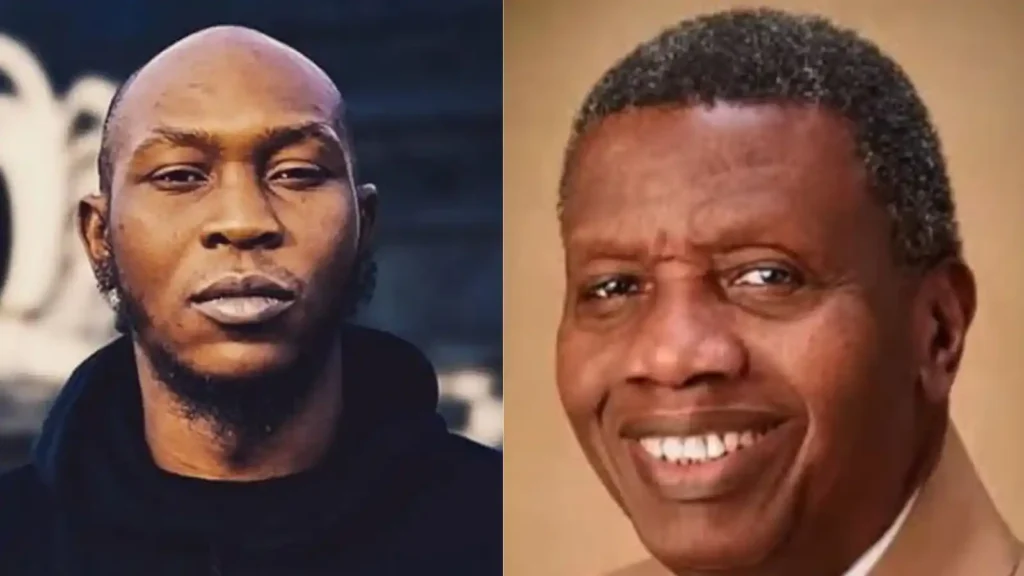
Following remarks he made about Pastor Enoch Adeboye, the General Overseer of the Redeemed Christian Church of God (RCCG), over an alleged event involving a terminally ill cancer patient, Afrobeat artist and social critic Seun Kuti sparked intense public outcry.
In a recent public speech, Kuti made the accusation while denouncing what he called the exploitation of weak people by certain religious leaders in the name of faith and miracles. Since then, his comments have sparked heated debate on social media and traditional media platforms, especially in relation to questions of medical ethics, accountability, and religious influence.
Leke, the son of Pastor Adeboye, confronts a three-person tribunal for calling RCCG ministers goats and won’t say sorry.
Seun Kuti claims that the incident included a wealthy Nigerian woman who had received a terminal cancer diagnosis from a specialist abroad. According to him, the doctor told the woman’s family that her condition had progressed and told them to get ready for her last days.
According to Kuti, the woman and her kids chose to go back to Nigeria in pursuit of spiritual guidance after rejecting the medical diagnosis. When they returned, he said, they asked Pastor Adeboye for his prayers, and he supposedly told them that the woman would not perish.
According to Kuti’s story, during the intervention, the cleric allegedly took $250,000 from the family. He further said that the woman eventually died in spite of the promises made.
Kuti continued by saying that the woman’s children went back to the cleric to ask for more explanation after her passing. He claims that Pastor Adeboye ordered them to wait outside while he prayed for the woman to resurrect and that he informed them that God intended for her to die if she did not wake up within an hour.
Kuti claimed that such occurrences underscore what he sees as the manipulation of faith and desperation for financial benefit, saying, “These are the kinds of things people don’t want to talk about.”
The claims have not been independently confirmed, and neither the Redeemed Christian Church of God nor Pastor Adeboye’s agents have responded to them formally as of the time this article was filed. Additionally, the family purportedly implicated in the incident has not confirmed anything.
However, the remarks have rekindled more general discussions regarding religious leaders’ involvement in healthcare choices, especially when it comes to terminal conditions. While some critics have justified faith-based therapies as a matter of personal conviction and choice, others have voiced concerns about the emphasis on spiritual answers rather than medical guidance.
Pastor Adeboye’s supporters have noted the cleric’s longstanding reputation and influence both in Nigeria and abroad, characterizing the accusations as unsupported and politically or ideologically driven. They contend that religious leaders should not be held accountable for events beyond human control because they are frequently consulted alongside medical specialists.
However, detractors have demanded that religious organizations be subject to further scrutiny, particularly with regard to the financial demands made on members and those seeking divine healing. Regulators have been asked by some to look into claims of miraculous healings and the monetization of faith, especially when vulnerable people are involved.
Known for publicly criticizing social, religious, and political institutions, Seun Kuti has regularly criticized what he sees as systematic exploitation in Nigerian society. His most recent comments follow a string of divisive ones that have established him as one of the nation’s most outspoken opponents of organized religion.
Informed consent, ethical limits in religious practice, and the need for more transparent public education on medical realities—particularly in cases of terminal illness—have all been resurrected by the episode.
Observers point out that the incident highlights a recurring conflict in Nigerian society between faith, medicine, and accountability as responses keep coming in. It is unclear if the accusations will lead to an official response or additional research.
About the Author