

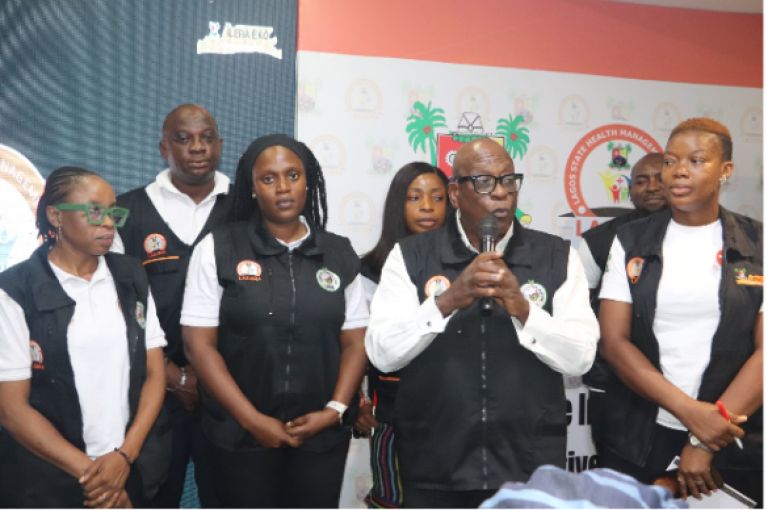
Following a strategic discussion between the Lagos State Health Management Agency (LASHMA) and Medical Directors of General Hospitals, public secondary health facilities in Lagos State are preparing to implement the mandatory social health insurance policy.
According to the Daily Independent, the meeting, which took place in Ikeja on Tuesday, aimed to expedite the implementation of Governor Babajide Sanwo-Olu’s Executive Order, which requires health insurance coverage for all Lagos residents. General hospitals were recognized as crucial facilitators of compliance and service delivery.
Speaking, Dr. Emmanuella Zamba, Permanent Secretary of LASHMA, characterized the interaction as a crucial stage in converting the Executive Order, which was signed on July 16, 2024, into real advantages for locals. She pointed out that the strategy, which was further strengthened by a September 2025 presidential directive, puts healthcare providers at the forefront of the state’s efforts to achieve universal health coverage.
According to Zamba, medical directors have a significant duty to operationalize the mandate as the heads of public secondary healthcare facilities.
She clarified that general hospitals are obliged to provide services to insured patients, confirm confirmation of enrollment under the Lagos State Health Scheme, and make sure uninsured patients are immediately registered at the point of care.
She explained that regardless of insurance status, no patient in need of emergency care should be refused rapid stabilization in accordance with the Executive Order.
She emphasized the significance of rigorous adherence to authorized operational rules, adding that care given on the day of enrollment would only become chargeable after the insurance plan was activated.
She claims that LASHMA has implemented a number of support systems to help hospitals, such as provider-led enrollment procedures, enrolllee verification tools, and LASHMA-AID, a structured emergency care framework that will formally launch on Thursday, December 18, 2025.
Zamba reiterated the organization’s dedication to ongoing development, pointing out that the interaction made room to pinpoint bottlenecks, resolve ambiguities, and increase cooperation between LASHMA and medical professionals.
She stated that many locals are “truly sick of paying out-of-pocket” for medical care, drawing inspiration from the subject of 2025 Universal Health Coverage Day. She urged hospitals to contribute to changing the narrative by successfully implementing the ILERA EKO health insurance program.
Additionally, Dr. Abimbola Mabogunje, Permanent Secretary of the Health Service Commission, said the meeting was appropriate given the growing public desire for the Social Health Insurance Scheme to be fully implemented. According to her, the session facilitated candid conversations about the challenges hospitals face and doable solutions to enhance enrollment and service provision.
Mabogunje referenced studies that revealed the majority of families were forced to pay out-of-pocket for care since just a tiny percentage of children receiving care in certain public facilities had health insurance. She emphasized that having health insurance offers peace of mind and financial security, both of which are essential for attaining universal health coverage.
She called on general hospitals to set an example, pointing out that they are in a unique position to provide complete insured treatment because they are government-owned, multispecialty facilities. She emphasized that continued cooperation will be necessary for success and urged LASHMA to continue being receptive to provider concerns.
Mr. Tosin Awosika, LASHMA’s Coordinator of Regulations, gave a presentation outlining the Executive Order’s legal and policy underpinnings and stating that it harmonizes the National Health Insurance Authority Act of 2022 with the Lagos State Health Scheme Law.
He emphasized clauses pertaining to mandatory enrollment, verification prior to service access, and extra safeguards for vulnerable populations and emergency situations.
According to Awosika, healthcare facilities must set up operational ILERA EKO desks, offer participants round-the-clock assistance, register uninsured individuals on-site, and refrain from any behavior that would erode public trust in the program.
Dr. Olugbenga Fadipe, Head of ILERA EKO Medical at LASHMA, addressed service delivery concerns by discussing recurrent difficulties found through monitoring and enrollee feedback. In addition to asking for specific channels of communication between hospitals and the agency, he called for better internal coordination within hospitals, accurate interpretation of benefit packages, and attention to staffing and workflow shortages.
About the Author