
“I’ve always wanted to go to college. If I had known that the employment market would be like this, when employers yell at you for not having a degree, I would have gotten a certificate a long time ago.
Bernard Chike, a 27-year-old unemployed man from Lagos, said these comments. He was feeling hopeless because he just had a Senior School Certificate.
Chike’s mother, a smart entrepreneur, died when he was 18, not long after he finished high school.
“That’s when my first chance to go to college went up in smoke. Almost all of my aunts and uncles who came to comfort us after my mom died drew me aside and said, “You have to become a man now.” A man? I was just 18, which was a really young age for me to be figuring things out! He told Saturday PUNCH, waving his hand in disgust.
After his mother’s funeral, the family went through a tough time financially.
Neoprene brace for running with knee support and tendon strap for arthritis
Knee Support Tendon Strap Running Neoprene Brace Arthritis Bandage
eBay UK
·
Paid for
emblem for a call to action
more
His father told him and his older brothers to take care of themselves.
“It was in 2016, during the recession. Our father told me straight out that he couldn’t feed or take care of me anymore, that there were only males in his house, and that I should forget about school and find a low-paying job. Since my older brothers were already working, I had to get a job in a factory near our residence in Ikorodu.
“If even one of my relatives had been willing to pay for my education, I would have gone to college despite the odds.” One of my aunts even warned me not to call her since she had her own troubles to deal with. “I had to accept my lot,” Chike said.
“I almost made a fake certificate.”
Chike’s circle of friends grew slowly over the years. He got back in touch with some of his old high school classmates and met new people through social media.
Open a UK business account, open a business account, or open a Revolut business account.
Open a business account in the UK, or a Revolut business account.
revolut.com
·
Paid for
emblem for a call to action
more
Stanley (last name withheld) was one of these friends. He was a project manager at a private company and seemed to be “living the life.”
“Most of my buddies from high school who went to college had better chances. Every time I saw them, I felt very bad about myself, so I didn’t tell many people that I didn’t have a degree. I started reading books and memorizing terms from dictionaries to disguise my flaws and show off my grammar.
“But Stanley was doing well.” I desired his life, so one day I told him. I informed him I didn’t have a degree and that most of the jobs I discovered needed at least an OND, HND, or BSc.
He stopped for a moment to remember what had happened. “At first, he stared at me like he couldn’t believe it because he knew I could speak and write English well. Then he told me to make a fake certificate. He said he could help me achieve this if I was ready. He said he would take me to a facility where they would make me a fake degree that I could use to get a job.
Chike added that another acquaintance told him about a job opening at Idumota and said they would accept his SSCE qualification. He couldn’t afford the cost of making a fake certificate.
After two weeks of talking, the manager of a retail complex in Idumota offered Chike the job. He was so excited that he left his house on the morning of October 20, 2025, eager to start his new job.
But his happiness didn’t last long. Later that morning, the plaza’s owner showed up and asked to see his certificates.
“The manager, who I thought had settled the situation, was stammering as the owner stared at my SSCE score with disgust. “Is this the only thing you have that makes you qualified to work here? You want us to pay you N100,000 to do it?” “the man asked. “I felt the same shame I had felt many times before when I was close to getting a job,” Chike recalled, holding back tears.
He told Saturday PUNCH that he would eventually think about making a fake certificate to get a job.
He sadly admitted that he might have to work minimum-wage jobs for the rest of his life when he was reminded that forging certificates is a crime.
The “cookers” of the certificate
Saturday PUNCH’s research shows that credential fabrication has been a problem in Nigeria for a long time, mostly because of high levels of unemployment and underemployment.
The National Economic Summit Group says that as of the first quarter of 2024, Nigeria’s unemployment rate was 5.3 percent, up from the previous quarter. Women (6.2 percent) and people who live in cities (around 6 percent) had higher rates than men (4.3 percent) and people who live in rural areas (around 4.3 percent).
People who really need particular academic credentials but don’t have them often use forgery agents to change existing documents or make fake diplomas for a charge. People may steal other people’s credentials or use them without their permission to get jobs, promotions, licenses, or official registration.
A Daily Trust reporter recently went undercover and got phony certificates from Oluwole, a well-known forgery hub in Lagos. They then used these certificates to get teaching jobs at two schools in the state.
Oluwole, a well-known part of Lagos Island, has been a center for making and selling fake documents for decades. These documents include school certificates, passports, visas, and government papers.
The so-called “certificate cookers” worked freely until 2005, when the Nigeria Police, the Economic and Financial Crimes Commission, and the State Security Service raided their den.
Sunday Ehindero, the then-Inspector-General of Police, reported that 115 individuals were paraded and that fake bank statements, official stamps and seals, blank marriage certificates, certificates of incorporation, and foreign driver’s licenses were found.
The den was torn down and replaced with a new shopping center, but Saturday PUNCH learned that the “Oluwole phenomenon” is still happening in more secret ways.
Syndicates increasingly use digital tools to change real institutional documents for people who want to work for them.
“There are people in Lagos that make fake certificates. It all depends on how much you need it and how much money you have. They are no longer ignorant criminals who work in the open; they are smart and know how to use technology.
A source told our reporter, “These guys use advanced software to make fake NYSC, university degrees, licenses, and any other paperwork you can think of.”
The Nigerian Police and the Independent Corrupt Practices and Other Related Offences Commission are both working to find and punish anyone who fake certificates. The ICPC said in a report that between 2015 and 2018, more than 721 people got jobs at six government agencies using fake certificates.
Not seen for ten years
The arrest and arraignment of bogus doctor Martins Okpe by the ICPC shocked both professionals and the general public. What made his situation so shocking was that he had been the chairman of the Nigerian Medical Association in Abuja and had even led the federal government’s group of medical specialists to Liberia during the last Ebola outbreak.
Saturday PUNCH learned that Okpe worked for the Federal Ministry of Health in Abuja as a Senior Medical Officer on Grade Level 12 in 2006.
Okpe pretended to be a doctor and got paid monthly wages and allowances until the authorities caught up with him in 2015. At the time, he was known as “Dr. Daniel George,” a name he had stolen.
In June 2015, the Medical and Dental Council of Nigeria caught him during a verification exercise. He had shown them his certificates to get permission. The ICPC found that Okpe had stolen a Bachelor of Medicine and Bachelor of Surgery degree from Ahmadu Bello University in Zaria, as well as NYSC certificates from his childhood friend, Dr. Daniel George.
Okpe was charged with impersonating George by using his complete identity and the three stolen certifications to get a job with the Federal Government.
He also got a staff ID card in George’s name and used it to apply for a postgraduate training program that would have given him a Master’s degree in Epidemiology Practice.
Section 383 of the Criminal Code says that what he did was against the law, and Section 390 says that he could be punished for it.
In 2016, the ICPC charged Okpe with seven counts before Justice Abubakar Kutigi. They said he lied to the Chairman of the Federal Civil Service Commission to get a job with the FMOH in 2006.
Section 25 (1)(a) of the Corrupt Practices and Other Related Offences Act, 2000, says that this crime is penalized under Section 25 (1)(b).
The ICPC said that Okpe worked as a “doctor” for ten years using bogus documents and got paid and given allowances that added up to N17.2 million.
Justice Kutigi of the Federal Capital Territory High Court, Jabi, said in November 2024 that the problem of fake doctors had gotten out of hand. He gave Okpe six months in prison for each of the seven offenses, for a total of four years and two months.
The judge also told him to give back the wages and benefits he got by mistake. If he didn’t, he would have to spend another year in jail.
Dr. Benjamin Olowojebutu, the NMA’s Vice-President, said that the conviction was a strong warning to anybody who practice medicine without a license or pretend to be a doctor.
“We thank the courts for their action. He stated, “We hope other cases will be handled with the same level of urgency.”
Fake papers
Nigeria is still having problems with fake certificates. On July 4, the EFCC’s Lagos Zonal Directorate 1 brought Anthony Ebikonbo-Owen before Justice Daniel Osiagor of the Federal High Court in Ikoyi on three counts of conspiracy to commit fraud, forgery, and having fake papers.
Justice Osiagor put the case on hold until July 24 and sent him to jail, even though he said he wasn’t guilty.
In Delta State, the civil service found a lot of fraud among public workers, including falsifying their ages and certificates.
Fred Yoro, the Permanent Secretary of the State Civil Service Commission, told certain personnel in a circular on April 22, 2025, to bring all of their academic and professional documents before the verification committee.
Roseline Amioku, the head of the state civil service verification committee, was upset over the many phony certificates that were found. She promised to fire any employees who were responsible.
“For example, a mother was caught working with her daughter’s certificate, using her daughter’s identity and age to get paid by the government. “Some of the cases we found are shocking and hard to believe,” she said.
Punishments under law
Lawyer Cyril Ugonna talked about the legislation and said that under Section 463 of the Criminal Code, general forgery offenses can get you up to three years in prison, depending on what kind of document it is. Some forgeries, such those involving public debt, a will, or precious stocks, can get you seven, 14, or even life in prison.
“Sections 362 and 364 of the Penal Code also deal with forgery crimes, which can result in up to 14 years in prison, a fine, or both. Ugonna said, “Using a forged document dishonestly is punishable in the same way as forging it yourself.”
Government workers in ICPC net
On Monday, the ICPC found Hassan Abdullahi, a Superintendent of the Nigeria Security and Civil Defence Corps, guilty of crimes involving certificate fabrication and getting corrupt benefits.
Justice E. Okpe of the Federal Capital Territory High Court in Abuja convicted Abdullahi guilty on two counts brought against him by the commission.
During the trial, ICPC prosecutor Hamza Sani showed that Abdullahi had submitted a fake Nigeria Certificate in Education from Adamu Augie College of Education in Argungu, Kebbi State, to the NSCDC in December 2010 in order to get ahead in his profession.
The crime is against Section 366 and can be punished under Section 364 of the Penal Code Act. As a result, the court gave Abdullahi a choice: two years in prison or a fine of N2,000,000.
On the second count, the court found that Abdullahi, who was a public official at the time, used his position to give himself an unfair advantage by getting salaries and benefits that were due to him because he was a Senior Inspector, based on the fake certificate he had already submitted. This action broke Section 19 of the Corrupt Practices and Other Related Offences Act, 2000. The judge gave him five years in prison with no chance of a fine.
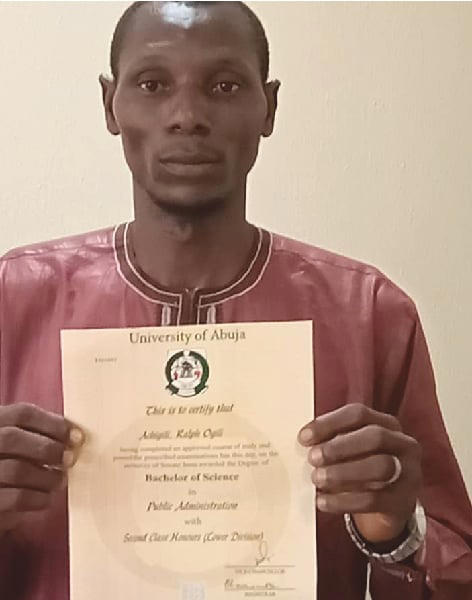
The ICPC detained Edwin Onyuwe and Achigili Ogoli, two officials of the Federal Road Safety Corps, almost four years ago for forging certificates. Sunday Okpara and Abdulrahman Razak were two participants of a forgery ring who made bogus University of Abuja credentials for FRSC officials.
Dr. Boboye Oyeyemi, the Corps Marshal, filed a complaint that the two officials had submitted fake BSc degrees in Public Administration in order to be promoted to officer cadre. This led to the arrests.
The University of Abuja verified that the certificates were fake.
Onyuwe and Ogoli, on the other hand, said the documents were real and that they had paid a university employee N500,000 to make false records. The ICPC found that the two had multiple course carry-overs in the university’s Distance Learning program and could not graduate.
The officials are said to have paid the forgery group N430,000, with Onyuwe getting N230,000 and Ogoli getting N200,000 for the fake certificates.
Razak, who said he was a printer, revealed that he utilized an authentic certificate he had from a buddy to make the fake better.
FG puts fresh plans into action
The Federal Government recently ordered the National Policy for the Nigeria Education Repository and Databank to be enforced across the country in an effort to stop certificate racketeering. Starting on October 6, 2025, the order says that all workers and new hires in government and higher education institutions must have their academic qualifications checked.
Dr. George Akume, the Secretary to the Government of the Federation, sent a service-wide circular on August 8, 2025, telling all ministries, departments, agencies, and public and private higher schools to use the National Credential Verification Service from the NERD program.
Now, every certificate, diploma, and award must be able to be verified and traced. An employee’s documentation must include NCVS clearance, which includes a National Credential Number.
A month ago, a Joint House Committee on Alleged Cases of Certificate Racketeering, led by Abubakar Fulata, met with the Minister of Interior, Olubunmi Tunji-Ojo, to talk about how trustworthy Nigerian citizenship documents are and how important it is to have strong verification processes.
“As government authorities, we are committed to making sure that only real people with validated credentials can take advantage of national opportunities. Fulata said, “Our talks also made it clear how important data integration is in the fight against certificate racketeering, which often takes advantage of gaps that already exist.”
Ayomide Aderounmu, an economist, said that a society that makes wealth and power seem cool often leads young people to fabricate certificates.
“People who counterfeit or use someone else’s certificates are looking for illicit ways to get real qualifications and enjoy the benefits that come with them. This is a common problem in many government agencies today, which is why background checks and frequent audits are so important. He said, “Anyone who gets caught must be turned over to the police and other relevant authorities.”
About the Author