
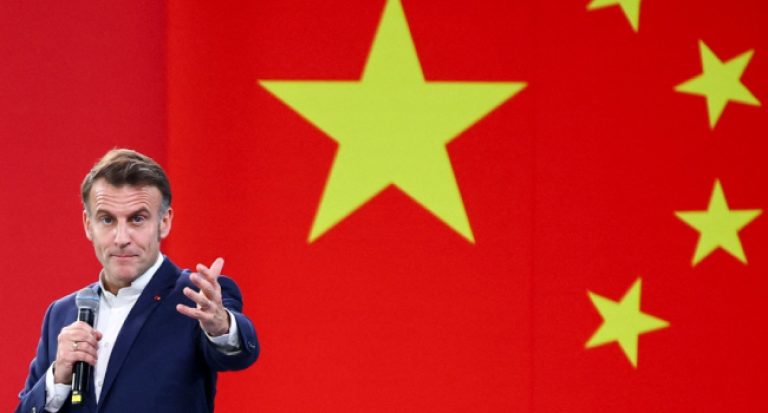
Emmanuel Macron, president of France, made comments yesterday in which he threatened penalties on Chinese imports unless Beijing cuts its huge trade surplus with the European Union.
“I warned them that we Europeans will be compelled to take strong action in the coming months if they do not react,” Macron stated in an interview with the business newspaper Les Echos during his official visit to China.
According to him, “such as tariffs on Chinese products, for example” are examples of American policies that could serve as models for similar actions.
According to Les Echos, the trade gap between the European Union and China, the world’s second-largest economy, surpassed €300 billion ($350 billion) in 2024.
Instead of each of the 27 member states deciding on their own trade policies, such as tariffs, the EU Commission does so.
Macron admitted that reaching a bloc-wide agreement on the China tariff issue was difficult; his country is the EU’s second-largest economy, behind Germany.
He stated that Germany’s stance on China continues to be “not yet entirely aligned” with theirs.
A compromise between the two nations was reached in October, reducing the 57% tariffs that the Trump administration had imposed on Chinese exports this year to 47%.
The European economic and technological paradigm has traditionally relied on machine tools and the vehicle, and Macron stated that China seeks to undermine this foundation.
In light of China’s “massive” re-directing of products originally intended for America towards Europe, Macron claimed that US protectionism has made matters worse for the EU.
What a predicament we find ourselves in today. According to Macron, this is a matter of paramount importance for the European industrial sector.
In order to lower the trade gap, Macron stated during his visit to China that the European Union should allow more FDI from China.
In an interview with Les Echos, he stated, “We cannot always be importing, Chinese companies must come to Europe.” He went on to say that European nations must not tolerate Chinese companies behaving like “predators” determined to achieve global dominance.
He argued that the European Union should do two things: increase competitiveness and safeguard its most vulnerable industries, including the automotive industry.
About the Author