
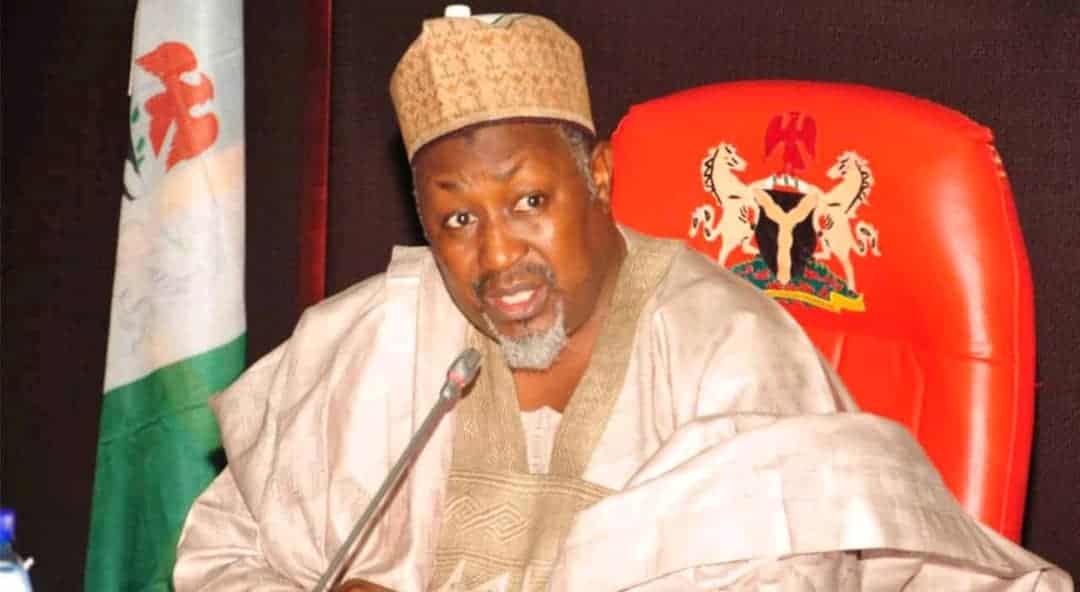
Mohammed Badaru Abubakar’s surprise departure as Minister of Defence could mean that other members of the Federal Executive Council would leave in the next few weeks.
The Guardian says that Badaru’s departure yesterday has already made people more curious about a possible cabinet shake-up.
No one can say for sure what the president will do next, but there are strong signs that more ministers could be let go as the administration gets closer to the 2027 election cycle.
Badaru’s resignation letter, which was sent to President Tinubu on December 1, ended his term in office suddenly, just as the country was stepping up its efforts to deal with rising security issues.
He said that health problems needed immediate and ongoing attention, which confirmed weeks of quiet suspicion about why he was doing fewer public events.
President Tinubu has accepted Badaru’s resignation and thanked him for his services, especially his work on coordinating defense and on ongoing changes to make the security system stronger.
Bayo Onanuga, the President’s Special Adviser on Information and Strategy, confirmed the resignation on his X handle in response to the news.
Badaru’s time in office, which was based on his expertise as a two-term governor, came at the same time as the administration’s increased attempt to improve the country’s security situation.
People close to the situation say that Badaru’s departure may be the first in a series of quiet but purposeful departures, which show that the Tinubu administration is making bigger changes.
Military experts claim that people who were paying close attention were not surprised by Badaru’s departure. certain people are still confused by how long he stayed in office, even if he made certain mistakes.
People in the defense community are increasingly saying that “it’s time for President Tinubu to change the defense hierarchy by appointing a career military professional who commands the loyalty and confidence of the armed forces.” This person should be able to use their grounded operational experience to get the results they want against insurgents and other violent groups.
In the meantime, a high-level meeting yesterday between traditional rulers and northern governors gave us new information about how serious the security situation is in the area.
Their universal support for state police is a big change in politics; it’s possible that it’s the first time northern politicians have all supported a proposition that used to be very controversial. The question today is: what changed?
It’s also important that they want mining activities to be put on hold for six months, which shows that they know that illicit mining is making the situation worse.
The meeting of northern leaders adds another layer to the changing political scene. Their united stance on state police, which has long been a source of disagreement among them, shows that governors, religious leaders, and traditional institutions are finally on the same page. Even more important is the growing stance of northern unity on national security issues.
The Northern States Governors’ Forum (NSGF) and the Northern Traditional Rulers’ Council both urged for the creation of state police in a statement after the conference. They said this was necessary to improve the security situation and boost collaboration in the region.
The communiqué was signed by Muhammadu Inuwa Yahaya, the Governor of Gombe State and the Chairman of the NSGF. It came out of a joint meeting at the Sir Kashim Ibrahim House in Kaduna.
The summit, which included governors from the 19 northern states and the chairmen of their traditional councils, praised northern officials for their “steadfast commitment to the unity, security, stability, and development of the region.”
The Forum noted that northern Nigeria is at a critical moment and emphasised that overcoming current challenges would require “unity, peer review, and cooperation.”
The governors also said they will keep their promise to deal with insecurity and other problems in the region “with firmness and clarity” as part of their constitutional responsibility.
It is yet unclear how the president will respond to these bold suggestions. Will these positions reshape national security policy, or further strain existing tensions within the government?
Badaru’s exit has revived longstanding concerns within the ruling party regarding performance benchmarks and loyalty expectations for ministers.
With the administration entering a more politically sensitive phase, insiders note that the presidency may be preparing to quietly offload underperforming appointees while fortifying its inner circle ahead of a high-stakes 2027 contest.
The methodical, almost silent nature of these removals mirrors President Tinubu’s established political style: gradual, strategic, and calibrated to send subtle yet unmistakable signals across the political landscape.
Within government circles, anxiety is now palpable. Some ministers are scrambling to showcase “impact milestones,” while others appear resigned to the possibility of being quietly removed.
The Badaru episode, therefore, is not just a resignation; it may mark the opening act of a broader consolidation drive. Northern leaders’ calls for a suspension of mining, a N1 billion monthly regional security fund for each state, and expedited constitutional amendments suggest that regional power brokers are no longer waiting for Abuja to dictate the pace of reforms. Instead, they appear prepared to shape the national conversation and challenge the centre if necessary.
Taken together, these developments point to a shifting political terrain: A presidency quietly recalibrating its cabinet.
A northern bloc newly emboldened and unusually united.
A national security climate growing more volatile by the day.
How the Tinubu administration navigates these overlapping pressures, internal, regional, and electoral, will determine not only the fate of his ministers but also the trajectory of Nigeria’s broader security architecture.
The days ahead will test alliances, expose policy contradictions, and perhaps reveal deeper fissures within the governing structure.
Badaru, 63, served two terms as governor of Jigawa State before he was appointed Minister of Defence on August 21, 2023. During his tenure, he worked closely with the service chiefs on procurement, joint operations, and harmonisation of national security strategies.
His resignation comes at a sensitive moment, as President Tinubu recently declared a national security emergency amid escalating threats across several regions.
The president is expected to outline the scope and operational framework of the emergency measures in the coming days.
About the Author