
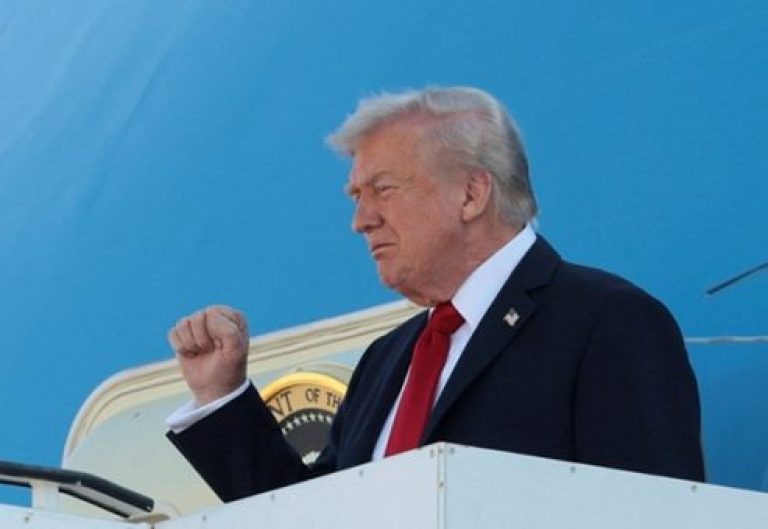
President Donald Trump declared on Saturday that the airspace above and around Venezuela should be thought of as “closed in its entirety.” He didn’t give any more details, which made people in Caracas nervous and confused as his administration puts more pressure on President Nicolas Maduro’s government.
Trump wrote on Truth Social, “To all airlines, pilots, drug dealers, and human traffickers, please think of the airspace above and around Venezuela as closed in its entirety.”
Officials in the U.S. who spoke to Reuters were astonished by Trump’s remarks and didn’t know of any active military actions to close Venezuelan airspace. The Pentagon didn’t answer requests for comment, and the White House didn’t say anything else.
On Saturday afternoon, Venezuela’s administration spoke out against Trump’s comments, calling them a “colonialist threat” to the country’s sovereignty and against international law.
The statement added that the U.S. president’s post “is a hostile, unilateral, and arbitrary act that goes against the principles of international law.”
A HUGE MILITARY BUILDUP IN THE CARIBBEAN
David Deptula, a retired lieutenant general who ran a no-fly zone over northern Iraq in 1998 and 1999, said that Trump’s declaration leaves him with more questions than answers. He stated that putting a no-fly zone over Venezuela might take a lot of planning and resources, depending on the goals of the airspace shutdown.
Deptula observed, “The devil is in the details.”
The Trump administration has been looking at ways to deal with Venezuela because it says that Maduro is responsible for sending illegal drugs that have killed Americans. The Venezuelan president, who is a socialist, has denied any ties to the criminal drug trade.
Reuters says that the U.S. is thinking about trying to remove Maduro, and that the U.S. military is ready for a new phase of operations after building up a lot of troops in the Caribbean and spending over three months attacking boats that are thought to be carrying drugs off the coast of Venezuela. Trump has also given the CIA permission to do secret operations in the country.
Maduro, who has been in charge since 2013, says that Trump wants to remove him from office and that the people of Venezuela and the military would fight against any such attempt.
Earlier this week, Trump assured members of the military that the U.S. would “very soon” start land operations to arrest suspected drug smugglers from Venezuela.
Venezuela accuses the US of having “colonial ambitions.”
People in Caracas who talked to Reuters didn’t like what Trump said.
Manuel Romero, a cooking assistant, said, “I think it’s unfair because people need to travel to work, do business, and see their family, and us Venezuelans aren’t to blame for these situations.”
Carmen Castillo, a lawyer, said she was worried that a lot of people wouldn’t be able to see their families outside of Venezuela over the holidays.
“We’re stuck here in Caracas, Venezuela. “Of course it affects us,” she replied.
The Venezuelan government said the U.S. was showing “colonial ambitions” in Latin America and asked the rest of the world to condemn what it called an unjust act of aggression. Iran, a Venezuelan ally that the US attacked earlier this year, called Trump’s declaration “a serious breach of international law and a threat to global aviation safety,” according to Iranian state news agency IRNA.
The Venezuelan government’s statement also said that Trump’s declaration was a one-sided end to the flights that were deporting migrants. Almost 14,000 Venezuelans had lately returned home from the U.S. In recent months, there have been two flights a week since the Trump administration is cracking down on immigration.
Maduro and other high-ranking officials in his government have spoken out against US imperialism in recent comments, but they haven’t named Trump specifically. This could be because the Venezuelan government is trying to calm things down, according to security and diplomatic sources. The Venezuelan government was angry with US Secretary of State Marco Rubio before, but even mentions of him have gone down in the past few weeks.
After the U.S. boat bombs, the government in the isolated northeastern Venezuelan state of Sucre has stepped up surveillance. Security agents and allies of the governing party are patrolling more, which is making people in the area afraid, according to four residents and one recent visitor.
GPS signals in Venezuela have also been disrupted in the past few weeks because of the U.S. buildup.
Trump’s declaration on Saturday came after the U.S. Federal Aviation Administration warned last week that major airlines could be in a “potentially hazardous situation” when flying over Venezuela because of “worsening security situation and heightened military activity in or around” the country.
Venezuela took away the operating rights of six major foreign airlines that had stopped flying to the country after the FAA notice.
About the Author