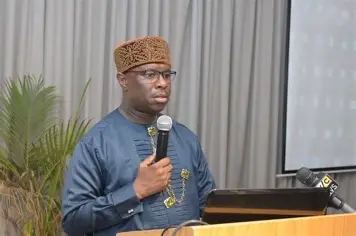


Dr. Olusegun Mimiko, who used to be the governor of Ondo State, has asked the Nigerian government to put more money into the country’s health and education sectors. He says that Nigeria will stay underdeveloped without these investments.
Mimiko said this today while giving the first convocation lecture at the Confluence University of Science and Technology (CUSTECH) in Osara. The presentation was called “Ill-Health and Illiteracy: Siblings’ Alliance Against Development.”
According to Vanguard, Mimiko argued that Nigeria has been underdeveloped because it hasn’t made enough investments in health and education.
He based his opinion on the country’s maternal health, life expectancy, government spending on health and education, nutritional status, literacy rate, research output, and patents.
Nigeria has less than three percent of the world’s population, yet it had 29 percent of the world’s maternal deaths, which means that one woman died every seven minutes. All of this points to the uncomfortable truth that Nigeria is the most unsafe place in the world to have a baby!
He added that Nigeria is one of only ten countries that have more than half of the world’s illiterate adults, with a total of 43 million. This is based on data from the UNESCO Institute for Statistics (UIS) from September 2025.
UNICEF says that one in three kids in Nigeria is not in school. This includes 10.2 million kids in primary school and 8.1 million kids in junior secondary school. It is interesting to note that Nigeria’s 18.3 million out-of-school children make up 15% of the world’s total. This number is bigger than the population of nearly 160 countries, according to Worldometer, 2025.
Mimiko joked that if the country didn’t fix its education and health gaps, it might not have any professional health personnel to turn to in ten years, only herb manufacturers and native doctors.
“While you may not completely agree with SUU’s methods or ability to negotiate collective bargaining, there is definitely something wrong with a wage structure that pays professors less than 500,000 naira a month, even if they have been in this academic career for more than 20 years!”
“It is about time we, once and for all, and in a justifiable and sustainable way, tackle the issue of emoluments and funding generally, in our tertiary institutions.
“This is definitely one of the best toolkits for dealing with the JAPA phenomenon, along with other clear benefits.”
He urged governments at all levels to pay attention to the two important areas and asked the federal government to keep up its current education measures, like NELFUND and digital literacy, to fill in these gaps.
“This is one strong reason why we should consider bringing back the school feeding program, but in a better way, with built-in openness in how it is carried out.
“I think the Federal Government should not be actively involved in implementation, but should instead be the program’s guardian angel, setting criteria and giving the sub-national government incentives to make it a part of everyday life while keeping an eye on compliance.
“Maybe our free school meal program should include at least one egg, one child, and one day. This will make it easier to keep track of compliance and accountability. It will also help our livestock business in a big way.
“Unquestionably, low investment of health and education can lead to, among others, poor human capital development, resulting in a less trained and less health workforce, reduced economic productivity and competitiveness, and greater poverty and inequality.
“On the other hand, socio-economic underdevelopment can lead to low government revenue, which makes it hard to give enough money to health and education and other important parts of the economy.
Childhood nutrition, which can affect education, health, and even agriculture, needs to be given special care. He said, “What the federal government does is what the sub-national government should do.”
About the Author