
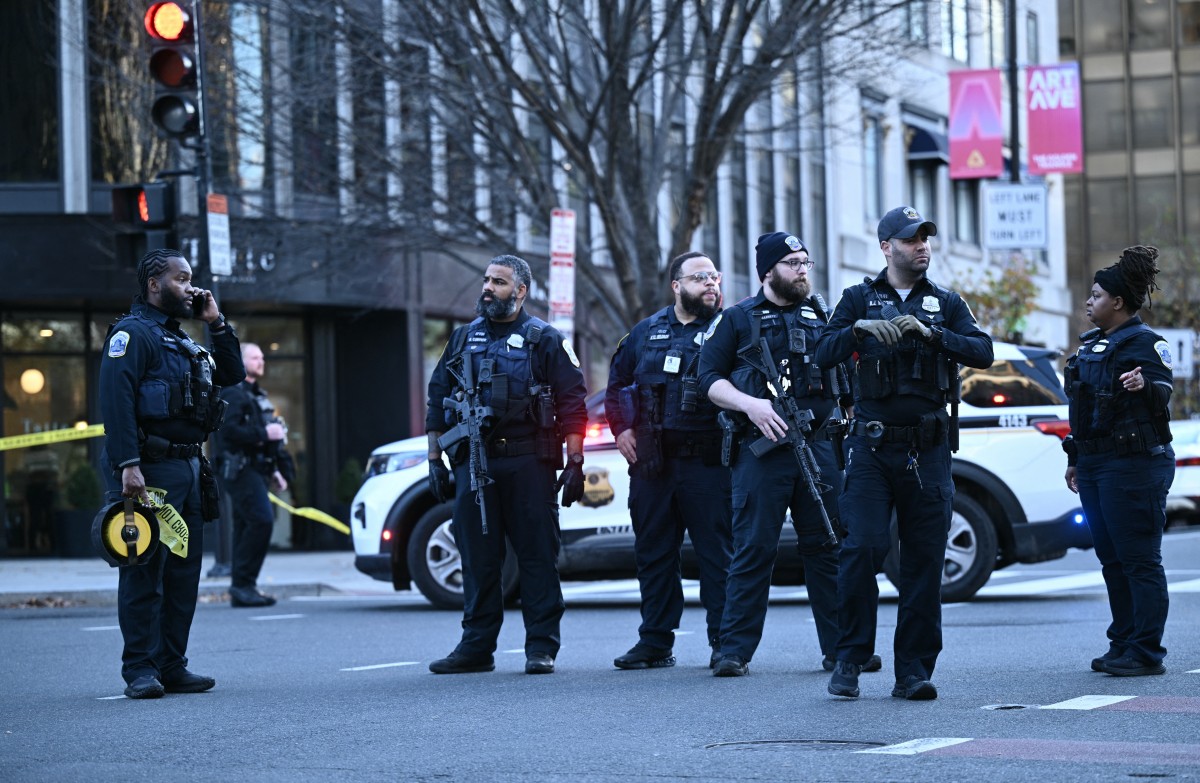
Law-enforcement officers secure the area after a shooting in downtown Washington, on November 26, 2025. On November 26, Police in Washington said they had detained a suspect after two National Guard troops were shot blocks away from the White House. "The scene is secured. One suspect is in custody," The DC Police posted on X. (Photo by Brendan SMIALOWSKI / AFP)
According to US news reports, the guy who is thought to have shot two National Guard soldiers outside the White House on Wednesday was an Afghan national who worked with US troops in Afghanistan.
Two blocks from the White House, US National Guard soldiers were shot and badly hurt. The police stated they had arrested the person they thought was the suspect.
Washington has called the violence a “act of terror” and said that it will be keeping a closer eye on immigrants who have come to the US from Afghanistan in the past few years.
We know this about the person who is thought to have shot:
Former Afghan Army
CNN, The New York Times, CBS, and NBC were among the several news organizations that identified the man as 29-year-old Rahmanullah Lakanwal and reported he came to America in 2021.
NBC was told by a family member of Lakanwal that he came after spending ten years in the Afghan army helping US Special Forces.
The family informed NBC that Lakanwal was from Khost province in southeastern Afghanistan and had spent some of his military service at a base in Kandahar province in the south.
Kandahar is where the Taliban was born, and it was the site of a lot of combat during the 20-year conflict between the militants and foreign-backed forces.
Arrival in 2021
Kristi Noem, the US Secretary of Homeland Security, said that the person who is thought to have shot someone “was one of the many unvetted, mass paroled into the United States under Operation Allies Welcome.”
She claimed the Afghan citizen, whose name she would not give, came to the United States on September 8, 2021, – than a month after the Taliban took over Afghanistan.
In February 2020, US President Donald Trump reached a deal with the Taliban to make it easier for a lot of US forces to leave Afghanistan by the end of that year. However, the timeframe was pushed out and the withdrawal happened under the Biden administration.
“Operation Allies Welcome”
As US troops were leaving Afghanistan, then-President Joe Biden started “Operation Allies Welcome” to help all the different government agencies that were helping Afghans settle in, including those who cooperated with US troops. This happened shortly after the Taliban took over Kabul on August 15, 2021.
More than 40% of the Afghans in the program were eligible for “Special Immigrant Visas” (SIVs) for those who took “significant risks to support our military and civilian personnel in Afghanistan” on behalf of the US government in Afghanistan, as well as their family members.
The initiative also let in other at-risk groups, like campaigners and journalists. Authorities have not said for sure if Lakanwal got a SIV.
The FBI and the National Counterterrorism Center, among other government organizations, checked the security of people who came to the United States through Operation Allies Welcome.
In September 2022, the Biden administration changed the name of the operations to “Enduring Welcome” (EW) to show that they were switching to a long-term approach that would focus on assisting Afghans get more stable, long-term legal status, mostly through the SIV program or the US Refugee Admissions Program (USRAP).
Big Evacuations
During the chaotic US pullout from Afghanistan, when Kabul’s airport turned into a mess as thousands tried to leave, Biden promised that his government would find a route out for those who aided the US.
During the 20 years of foreign presence, hundreds of thousands of Afghans worked for foreign military and embassies and joined US-funded NGOs. A lot of people were afraid that this would make them a target for violence, even by the Taliban.
The UN says that former Afghan officials have been killed or gone missing without a trial under Taliban rule, even though the Taliban said they would not punish former foes.
The US State Department says that since the Taliban took over, EW and its predecessor, Operation Allies Welcome, have moved more than 190,000 Afghans to the US.
According to charities that help people, tens of thousands more, including many former military translators and Afghan security forces members, are waiting to be resettled.
According to Shawn VanDiver, president of the AfghanEvac non-profit group, Trump’s broad new travel restriction on 12 countries, including Afghanistan, made things more difficult in June.
VanDiver said it was especially painful for some 12,000 people who were waiting to be reunited with family members who were already living in the United States.
About the Author