
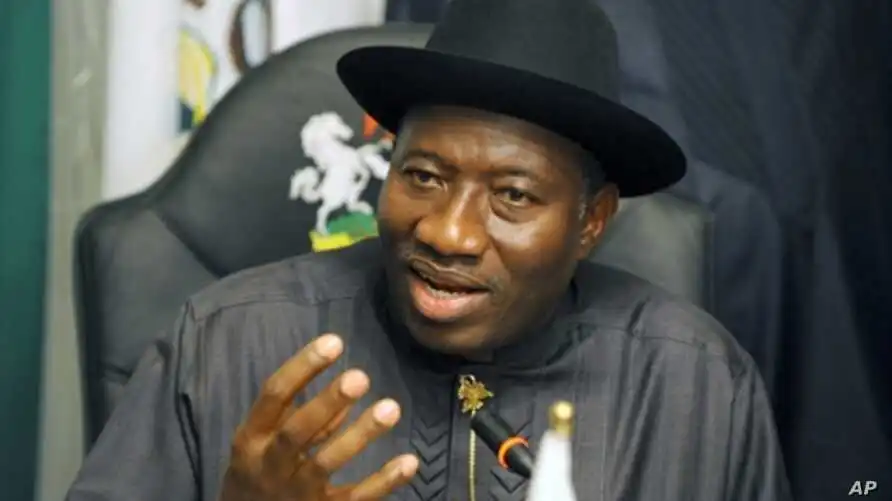
Jonathan, who used to be president of Nigeria, has explained why he hasn’t been active in politics lately.
Jonathan says that one reason he hasn’t been involved in active politics is because he is a member of the West African Elders Forum.
Jonathan said this yesterday in Abuja at an event called “Legacy of Impact, Celebrating Our Journey” to mark the 10th anniversary of the Goodluck Jonathan Foundation (GJF).
NAN adds that there was also a gala dinner at the event to celebrate Jonathan’s 68th birthday.
Jonathan told his coworkers that he wasn’t involved in politics because being a member of the WAEF means you have to be completely neutral in politics. He said that the forum was a form of preventive diplomacy made up of past heads of state who visit countries in the sub-region during elections to help keep things from getting out of hand when the polls are not run properly.
He said, “The idea is that yes, we watch the elections, but we are not co-observers.”
“We go there to make sure that if we see anything bad starting to happen, we step in and see what we can do to stop it from becoming a full-blown crisis.”
Jonathan also said, “That person must have been a president of both the sub-region and ECOWAS in order to be a member of the WAEF.” One clear condition is that you won’t be a politician anymore, which is why I’m letting down most of my political friends. As much as they want me to get involved in politics, I have to quit the WAEF first.
Jonathan spoke out against what he called “rascality” in politics and asked leaders to act with respect and responsibility when talking about the state of the country.
He noticed that while jobs like teaching need training and certification, a lot of people get into politics and leading roles without the right training.
“Politics needs to look different.” He said, “We need to see politics as the job of responsible people, not the job of wacky people who play in the car park.”
The former president was also very sad about the latest kidnapping of 25 girls in Kebbi State. He said it made him think of when the Chibok girls were kidnapped during his time in office. His sympathies went out to the families of the people who died, including a vice principal. He also asked people to pray that the kidnapped students would be found safely and that tragedies like this would stop.
Jonathan told the story of how his foundation came to be after losing the 2015 election. He said that investor Tony Elumelu came up with the idea. At first, he thought about broad issues like schooling and fighting poverty, but his advisors told him to focus on areas where he had credibility around the world.
He said that the Foundation decided to focus on democracy because of his work to strengthen the electoral commission and admit defeat before the 2015 elections were over, which was praised all over the world. Jonathan also said that even though he had studied and worked in environmental protection and was from the Niger Delta, he decided to let other people handle environmental issues and focus the Foundation’s work on democracy and government.
In her speech, Ms. Ann Iyonu, Executive Director of the GJF, said that the event was a chance to think about the organization’s ten years of work toward peace, development, and democratic government for everyone in Africa.
According to Iyonu, the Foundation has kept its promise to work for democracy, fairness, and progress through partnerships and strategic projects. She said that GJF is happy to say that “together they have turned bold ideas into transformative action” ten years later.
She talked about how the Foundation works to improve democratic institutions across the continent through policy dialogues, election observation missions, mediation missions, and strategic advocacy. She also said that the Foundation’s annual Democracy Dialogue, which began in 2021, has become an important place to connect and plan for action.
“This year in Accra, we got together with the theme ‘Why Democracies Die,’ which was a timely look into the structural and systemic issues that weaken democracy in Africa and around the world,” she said.
Iyonu also said that the Foundation’s work to build peace has led to peaceful political changes, improved the safety of African states and their people while upholding democratic ideals, human rights, and the rule of law.
She also said that the Foundation has helped stop violent extremism both online and off, built trust between the government and its people, and increased Africa’s presence around the world through partnerships with other countries.
About the Author