
The recent “hot mic moment” between Russian President Vladimir Putin and Chinese President Xi Jinping involved overhearing their conversation about living beyond 150 years old.
There is a probability of living to 150 this century, according to predictions, which Xi reportedly told Putin.
The first Emperor of China, Qin Shi Huang, spent a significant portion of his reign seeking an elixir of immortality, and their words reflect his activities.
It is thought that the chemicals he consumed, including poisonous mercury, caused his demise, thus thwarting his attempts to live eternally.
Chief Technology Officer Lyu Qinghua of Lonvi Biosciences, one of the many Chinese businesses developing anti-aging medicines, claims that although the pursuit for immortality may be out of reach, living to the age of 150 is definitely within the realm of science fiction.
‘Living beyond 150 is entirely conceivable,’ he told the New York Times.
So this is going to be the reality in a couple of years.
The development of anti-aging medicines has been a long-term focus for numerous Chinese laboratories, including Lonvi Biosciences.
These hospitals and labs are becoming richer and richer from the longevity industry in China.
Researchers in Beijing announced in 2021 that they had created a novel gene treatment that might slow or perhaps stop the aging process in mice.
According to Reuters, the mice’s lifetime was increased by 25% by Professor Qu Jing of the Institute of Zoology at the Chinese Academy of Sciences.
“Our ultimate goal is to discover a method to slow down the aging process, even if it’s just a little bit.”
The use of specialized super stem cells to halt the aging process in monkeys was another major development this year, thanks to researchers in China.
The study’s findings were published in the scientific journal Cell, which demonstrated that the medication improved the health of multiple organs in older monkeys.
Presently, anti-aging treatments are being developed by a number of Chinese laboratories and businesses.
A recent “hot mic moment” involved Russian President Vladimir Putin and Chinese President Xi Jinping, who were overheard talking about how to live to 150.
Researchers in Beijing said in 2021 that they had created a novel gene therapy that might slow down the aging process in mice and even make them live longer.
In addition to hosting anti-aging conferences, Shanghai-based Time Pie used to sell a variety of anti-aging supplements.
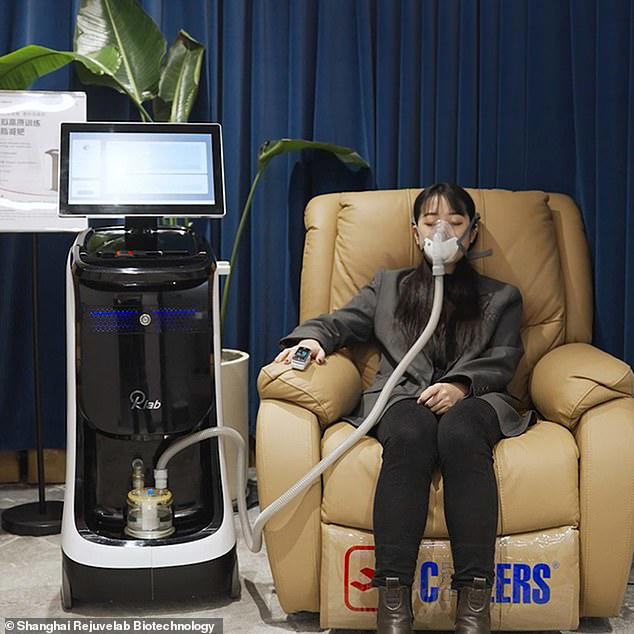
Among the many high-tech products offered by Shanghai Revitalize High Technology Co. are oxygen and red-light chambers, which the company claims can slow the aging process.
Efforts by Chinese laboratories to uncover the key to eternal youth mirror the country’s burgeoning healthcare infrastructure, which includes state-of-the-art hospitals, innovative research, and the widespread use of artificial intelligence (AI) in medical settings.
These state-of-the-art public and private hospitals are also jumping on the longevity bandwagon by establishing anti-aging and longevity specialized departments.
At these specialized clinics, patients usually undergo thorough health evaluations to determine their unique circumstances. Then, they are given personalized anti-aging advice, which may include dietary changes, medical treatments, and lifestyle adjustments.
According to Huihai International Medical Center’s explanation to 36KR, a Chinese tech news site, their business is not a magic medicine that will make you live forever, but rather long-term therapy and assistance.
A one-time service is not what longevity medicine is all about; it’s about providing clients with long-term, ongoing care.
Oxygen and red-light chambers, among other high-tech products, are on sale from Shanghai Revitalize High Technology Co., which claims to combat aging.
These medical centers and labs are becoming richer and richer because to the longevity industry in China.
For the simple reason that in an increasingly elderly nation like China—where the birth rate is falling and 300 million people are 60 and older—the idea of living longer is being considered by many, not only the country’s elite.
Longevity and anti-aging strategies are attracting the attention of a growing number of Chinese, particularly the younger population.
The West might stand to gain from China’s desire to live forever, given the growing trend of technological advancements being shared around the world.
According to the state-run China Daily, a collaborative “anti-aging” facility was established earlier this year in Beijing by US healthcare business Kenvue and China’s premier Peking University.
A gene-editing medication developed by AccurEdit Therapeutics became the first Chinese business to obtain FDA approval in May.
Lonvi Bioscience bets on a single pill, while many hospitals and labs talk about long-term ongoing treatment and lifestyle decisions.
A rising number of Chinese companies are developing anti-aging medicines, and Lonvi Biosciences is only one of them.
The CEO, Yip Tszho, is certain that this medication is the “holy grail” that would extend human life expectancy beyond 100 years.
In search of a remedy, they sought out Traditional Chinese Medicine (TCM), a system of medicine with deep roots in China that employs methods like herbal combinations for a wide range of ailments, including anti-aging.
A portion of grapeseed, which is popular in traditional Chinese medicine, can eliminate the damaging “zombie” cells that hasten the aging process, according to CEO Yip Tszho.
They used it to make a tablet that they say has anti-aging properties.
Yip is certain that this is the “holy grail” that will allow people to live beyond the 100-year mark.
About the Author