
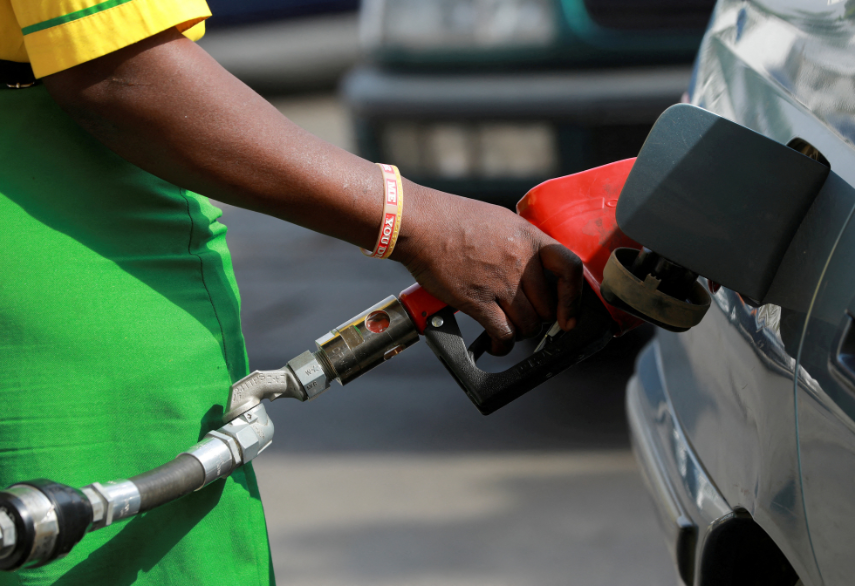
Some marketers and people in the oil and gas industry’s downstream sector were happy yesterday when the 15 percent ad-valorem import duty on Premium Motor Spirit (PMS) and Automotive Gas Oil (AGO), which are also known as petrol and diesel, was put on hold.
According to Daily Trust, they argued that the import tax won’t work until Nigeria can refine enough oil on its own.
The Nigerian Midstream and Downstream Petroleum Regulatory Authority (NMDPRA) has said that the charge is on hold.
George Ene-Ita, the Director of the Public Affairs Department, signed a statement yesterday that said this.
The 15% import duty has mixed effects on the downstream industries.
Some people thought it was a way to preserve local refineries, while others thought it could lead to higher fuel prices because Nigerians would have to pay for the predicted rise.
The Authority, on the other hand, assured the public that there is enough supply of petroleum products across the country, keeping volumes under the acceptable national sufficiency threshold during this time of high demand.
“The Authority wants to take this chance to tell people not to stockpile, panic buy, or raise prices of petroleum products in ways that don’t reflect the market.”
The statement further claimed, “It should be noted that the 15% ad-valorem import duty on imported Premium Motor Spirit and Diesel is no longer in view.”
The NMDPRA says that there is a lot of petroleum products available in the country, including PMS, AGO, and Liquefied Petroleum Gas (LPG). These products come from both local refineries and imports, which makes sure that depots and retail stores across the country always have enough stock.
“The Authority will keep a close eye on the supply situation and take the necessary regulatory steps to make sure that the supply and distribution of petroleum products across the country do not stop, especially during this time of high demand.
The statement went on to say, “While we appreciate the ongoing efforts of all stakeholders in the midstream and downstream value chain to ensure a smooth and uninterrupted supply and distribution, the public can be assured of NMDPRA’s commitment to guarantee energy security.”
“Why FG changed their mind”
The news of the import duty had gotten a variety of emotions from people in the government.
Major and independent marketers disagreed on whether the tax was a good idea. The Major Energies Marketers’ Association of Nigeria (MEMAN) claimed that the 15% import duty will cause prices to go up.
Mr. Clement Isong, the Executive Secretary of MEMAN, said that the tariff will have a big effect on the costs of PMS and diesel, which might go up to N1,100 and N1,200 per liter, respectively, making life much worse for Nigerians.
Damilotun Aderemi, the President’s Private Secretary, wrote a letter with the subject line “Re: introduction of a market-responsive import tariff framework on Premium Motor Spirit (PMS) & Diesel” that first notified the duty.
FIRS Chairman Zacch Adedeji asked the government to use the tariff to make import costs more in line with what they are at home. The president agreed.
According to Adedeji, the charge, which is based on the Cost, Insurance, and Freight (CIF) value, is likely to raise the price of petrol by about N99.72 per liter.
“The main goal of this initiative is to make crude transactions in local currency work, improve local refining capacity, and make sure that Nigeria has a steady, cheap supply of petroleum products that fits with Your Excellency’s Renewed Hope Agenda for security and fiscal sustainability,” said the FIRS.
But MEMAN said that the 15 percent tax is too high since it would be like putting a ban on gasoline imports, which is bad for energy security.
Isong said that, based on the present market trend and today’s landed costs, a 15% tariff would add N122.46 to PMS (N827.24 to N949.70), bringing pump prices to approximately N998/L in Lagos and N1,028/L in several upcountry markets. Diesel prices would go up to about N1,164-N1,194/L, depending on margins.
However, the marketers’ statement contradicted that of the Dangote Refinery, which is Nigeria’s largest single train refinery and has claimed that it can satisfy the daily needs of Nigerians.
The plant said it now delivers 45 million liters of premium motor spirit (PMS), which is also called petroleum.
It further added that the facility supplies 25 million liters of diesel per day and promised to keep the products available all over the country without any breaks.
However, even though Dangote promised that the policy would discourage imports and preserve local refineries, the opposition to the import duty continued until yesterday, when the idea was put on hold.
Otunba Adetunji Oyebanji, a big marketer and CEO of 11PLC, told our reporter, “Personally, I think there was a lot of pushback from a lot of people, just like there were a lot of people who supported it.”
Value-added tax on fuel is normally around 2%, as we heard from international speakers at the recent MEMAN webinar.
“Government must have thought about how much money it could make when it first suggested this move. Some others thought it was a way to defend local refineries, and even one specific facility.
He said that the U-turn must have been based on the reality that there isn’t enough consultation within and outside of government, as well as the political effects of expected increasing gas costs.
He said that this means that imports would keep coming in until there is adequate product available from the local refineries.
“This development will make sure that there is enough supply and that prices stay reasonable because no one group will have a monopoly on supply,” he said.
Prof. Wumi Iledare, a well-known expert of petroleum economics, told our correspondent that the reversal is typical of Nigerian politics.
“Babangida did the same thing during the SAP (Structural Adjustment Program) era: he ignored scholarly counsel and put political expediency ahead of sound economic thinking. This trend is still going on today.
He said that politicians don’t like to hear new ideas when they go against their short-term political goals. Sadly, politics still beats economics, and the country pays the price in the long run.
“Policy should be based on economics and evidence, and politics should only help make it happen. We will be going in circles around the same structural problems till then.
He also said that the 15% import tax should not have been seen as a political move, but as a way to stabilize the economy and the market.
“The goal is clear: to protect new local refineries, promote value addition in Nigeria, and slowly bring Nigeria’s downstream market in line with its growing industrial capacity.” This program was meant to lower the country’s reliance on imports, save foreign currency, and help refineries stay in business.
“Domestic producers like Dangote Refinery and the repaired NNPC plants need a little time to get their operations back on track and recoup their large capital investments. A lot of countries have used these kinds of temporary tariffs to help fledgling businesses grow.
He said that if governance fails, the obligation protects inefficiency; if it works, it opens the door to competition.
He went on to say, “The difference is in openness, order, and responsibility.”
Prices may go up a little bit in the near run, but it’s all part of the process of Nigeria becoming more efficient in the long term so that it can fulfill its own fuel demands at a competitive price. In this country, petrol costs between N890 and N965 a liter. In Benin, it costs between N1,800 and N1,875; in Togo, it costs N1,835; in Ghana, it costs between N1,550 and N1,995; and in Senegal, it costs N2,538. Nigeria is still the cheapest place to do business in the sub-region. The next step is to keep an eye on the borders and keep the markets in check to stop arbitrage.
Paul Alaje explains what suspension implies
Dr. Paul Alaje, a top economist, told our reporter that it was evident that the government didn’t conduct its research before putting the levy in place.
He said that he was okay with the import duty at first because Nigeria can make enough fuel on its own.
“But NNPCL has said that we don’t have enough.” So we need to figure out if we have it or not. If we have enough and are still importing it, I mean, we are putting the prohibition in place. We are just urging people to buy local because we have plenty. But if we don’t have it, that indicates we want to put pressure on people to buy things locally.
He remarked, “My thoughts would be that maybe the government has realized that we don’t have enough yet.” If they do, it will mean more money for the government, but if that cost is passed on to the final consumer, it will be an unfair policy.
“So the government should help local businesses become self-sufficient, like we have self-sufficiency in cement. But if we rush to put taxes in place when we don’t have enough, it’s like going back to Egypt.
“To that extent, our level of production sufficiency is what makes a decision good or poor. And we don’t know. According to Dangote Refinery, they have enough. NNPCL says we don’t have enough.
He said that the administration should always do study based on facts before making any decisions.
“Over the past 20 weeks, what has been the average amount of imports per week? If we have plenty, where are those folks selling their imports? Where do they sell the things they bring in? These are questions, then. So it’s more than just giving advice. It has to do with being objective in research. So, if we have done thorough study, we should be able to discern if we have attained sufficiency or not.
Duty would have started a trade war, according to one expert.
Samuel Caulcrick, a specialist on economics, said that the import duty may have started trade wars.
He said that increasing import duties might make things more expensive for consumers, slow down innovation, limit product choices, and cause Nigeria’s trading partners to take trade actions in response.
Caulcrick said that Nigeria could face similar inflationary pressures if it doesn’t find a balance between protectionism and global competitiveness. He cited a 2019 study on U.S. tariffs that found that American households paid an extra $3,300 a year because of price increases caused by tariffs.
He also said that preserving “infant industries” without a clear way to make them competitive might make them lazy and unproductive, which would keep the economy stuck in a loop of needing government protection.
He told the federal government to learn from China’s model of industrial growth, which he said included tariffs, but also protective measures, incentives for foreign investment, policies that focused on exports, and technological progress.
He went on to say, “Consumers and businesses in the US ultimately pay tariffs.” They have to pay more for imported goods and even for locally made equivalents that no longer have to compete on price.
“China’s economic growth wasn’t just based on limits on imports. It actively sought out foreign direct investment, constructed robust supply chains, and set up an export-led manufacturing structure that made sure it could compete globally.
About the Author