

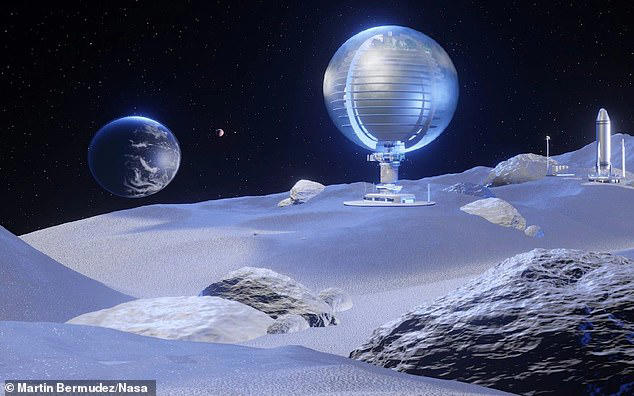
NASA has announced plans to send astronauts to live on the moon in glass bubbles manufactured from lunar dust.
The Telegraph says that the American space agency is paying for research on the big habitable circles that would be built on site.
When they got there, they would collect tiny shards of “lunar glass,” which is a part of the moon’s soil, or regolith, along with rocks and mineral fragments.
A “smart microwave furnace” and a regular microwave oven would be used to melt the material down.
A “smart microwave furnace” will be made to help melt the glass and blow it into a bubble, which will then form into a big, clear structure.
The American space engineering company Skyeports came up with the notion. They have already shown that this is possible by blowing glass balls out of lunar dust.
The company’s test spheres are only a few inches wide, but they want to make them hundreds or thousands of feet wide so astronauts may live in them.
The material used to form a circular habitat, which is planned to be between 1,000 and 1,600 feet wide, might be changed such that the glass would mend itself.
The American space agency is paying for research into the big habitable spheres (seen in designs) that would be built on site.
This is a particular kind of glass constructed of polymers that can put itself back together after being broken, like when micrometeorites or “moonquakes” hit it.


Solar panels may also be put on the lunar dwellings so they could make their own power.
Dr. Martin Bermudez, the CEO of Skyeports, wanted to envisage whole communities of spheres on the moon and other places in space, all connected by glass bridges.
“You’ll never be able to make Earth again, but this is pretty close, and one day we might even be able to put them in orbit,” he said.
He has always been fascinated in space and wants to use his degree in architecture to figure out how to build things on the moon or Mars.
Silicates, which are chemical substances that are typically used to produce glass, can make up as much as 60% of lunar dust. This is what made him think of the bubbles.
He also found out that glass may be made less brittle and even stronger than steel with more investigation.
He told Nasa about the idea about two years ago, and they liked it right away.
The idea is currently being looked into by the Nasa Innovative Advanced Concepts (NIAC) program, which funds projects that could change the aerospace industry.
And its in situ construction is appealing because it’s hard to create things on the moon, and moving materials there is quite expensive.
To blow the molten glass, huge gas pipes would be used. After the bubble has formed, they would be used to make the entrance.
We would 3D print any interior parts utilizing materials found on the moon’s surface.
Skyeports says they chose a sphere because it is a very strong shape that spreads pressure evenly.
It was also stated that building it out of clear glass was good for the mental health of astronauts.
Dr. Bermudez said, “The shape of a sphere happens on its own because at that temperature it becomes an amorphous liquid. When it is extruded out of a furnace in low gravity, it will take on the shape of a sphere.”
You will also need to mix elements like titanium, magnesium, and calcium with the lunar glass to make it stronger.
It is also envisaged that layers of bubbles might be made, with one side being warmer and the other side being cooler to generate condensation.
This would let astronauts grow plants and food and establish an ecosystem that makes oxygen.
The development teams also want to know if a glass bubble that big could make enough electricity to run the whole system.
In January, the blowing technique will be tested in a thermal vacuum chamber. After that, it will be evaluated in a microgravity condition.
It will eventually be tested on the International Space Station, and experiments on the moon itself could happen in the next few years.
While NASA figures out if people could live on the moon, astronauts may go back there to visit.
The Artemis program says that the agency could send people to the moon in the next five years. Right now, they are looking for the right places for them to live while they are there.
“We’re in a race against time because Artemis is moving so fast,” Dr. Bermudez remarked.
Clayton Turner, who works for NASA’s Space Technology Mission Directorate, which is in charge of new technologies, said, “Our next steps and giant leaps depend on innovation. The ideas that come out of NIAC could completely change how we explore deep space, work in low-Earth orbit, and protect our home planet.”
“This program keeps changing what’s possible, from making small robots that can swim through the oceans of other worlds to growing space habitats from fungi.”
Researchers at Aalen University in Germany said in 2023 that buildings and roads might be built on the moon using bricks produced from lunar dust that had been blasted with a laser.
The space agency’s summary of the research says, “This new method involves melting lunar glass compounds in place and building a large spherical shell structure, which is a big change from how habitats are built now.”
Building things the old-fashioned way, like with prefabricated pieces, 3D printing, inflatable systems, and complicated assembly, takes a lot of time and effort.
On the other hand, the idea of blown scalable glass structures uses moon glass resources and comes up with a new way to make things on the spot.
It goes on to say, “The idea of building monolithic glass habitats on the moon has a lot of potential for the future of space exploration and living there.”
“It inspires a pioneering spirit by imagining a new era of self-sustaining off-world habitats, which would be very good for NASA, the aerospace community, and all of humanity.”
About the Author