

Russia received over 40,000 applications for state-funded university spaces in 2025, with over 5,000 spots going to African students. Rossotrudnichestvo, Russia’s cultural diplomacy organization, reports that this year they received twice as many applications as in 2024. Sudan, Guinea, Ghana, and Chad had the most candidates. Russian language classes are also gaining popularity, according to officials.
It is not unexpected, according to observers, that African students are seeking further education in Russian colleges. As part of its strategy to increase its global influence in the face of Western isolation, President Vladimir Putin’s Kremlin has been actively courting African allies and reviving ties from the Soviet period.
Russia has been courting countries in the Global South as a means of coping with its growing international isolation since its 2022 invasion of Ukraine. Russian engagement strategies have focused on energy, education, and military cooperation.
The cheapest approach to get allies is to offer scholarships. Historian Irina Filatova of Russia, who is a professor emerita at South Africa’s University of KwaZulu-Natal, told DW that Russia is in need of allies right now. “Russia has created an image that projects it as anti-colonial, and Africans agree with it.”
Compared to Russia, the number of African students studying in the EU and US is currently far higher; a survey conducted in 2013 estimated that over 92,000 African students were enrolled in French universities alone.
Russia has stepped up its attempts to show solidarity with African nations, especially those in the Sahel region like Mali.
Russia has stepped up its attempts to show solidarity with African nations, especially those in the Sahel region like Mali.
Raising one’s cultural profile
As part of its “Russian Houses” initiative, Russia has declared its intention to increase its cultural and educational influence in Africa by opening more centers across the continent.
During the Russia-Africa Expo 2025 in Moscow in October, Rossotrudnichestvo president Yevgeny Primakov announced plans to establish new facilities in Egypt, Zambia, Tanzania, South Africa, and Ethiopia.
“Russian language courses are now offered in many African countries, and attending them opens the door to Russian scholarships, universities, career opportunities and a new way of life,” according to him.
Scholarship applications have been on the rise, which can be attributed, in part, to the proliferation of Russian Houses, language programs, and state-funded study grants. University students in the Central African Republic are now required by law to take Russian language classes. The Central African Republic’s president, Faustin-Archange Touadera, depends on Russian military backing, and there is already a substantial presence of Russian military advisers and commercial contractors in the country.
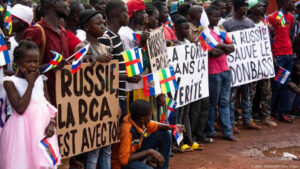
A pro-Russian voice has been heard among those who support Faustin Archange Touadera, the leader of the Central African Republic.
However, detractors contend that Russian Houses are actually hidden propaganda outposts that spread Kremlin narratives overseas.
Concerns have been voiced by human rights groups regarding allegations that certain international students have been coerced into enlisting in the Russian military as a condition for visa extensions or legal status.
According to other students who were detained by the Ukrainian army, they were forced to sign military contracts in fear of being deported or imprisoned if they did not. Some have fallen for other parts of Russia’s war effort, like working at companies that produce weapons and ammunition. Russian efforts to project soft power could be jeopardized, according to experts.
“It is very bad for the Russian image at the moment to invite people to study and pay for their studies if they end up doing something different,” Filatova remarked, stating, “Russia needs African countries as allies, not enemies.”
Past Soviet echoes
Moscow portrayed itself as a reliable ally to the newly independent nations of Latin America, Africa, and Asia throughout the Soviet era.
Soviet universities educated thousands of students from non-aligned nations, many of whom went on to prominent positions in politics and business.
In 1960, the Patrice Lumumba People’s Friendship University of Russia was founded to educate students from underdeveloped nations and further Soviet foreign policy goals. This university stood as a symbol of this.
Student access to low-cost higher education in Africa
In addition to the obvious geopolitical factors, Russian institutions offer far more affordable tuition and living costs compared to their Western and even some African counterparts.
According to Keith Baptist, a Zimbabwean dad with three dependents studying in Russia, “Russian universities are way cheaper than studying in Europe or some African countries.” So stated Baptist.
“Accommodation and food are also way cheaper in Russia compared to a student learning here in Zimbabwe,” according to him.
Russian medical schools and other specialized institutions charge between $2,000 (€1,719) and $10,000 (€8,596) per year in tuition, while their American and European counterparts charge between $20,000 and $40,000.
A Zimbabwean named Jefry Makumbe, who graduated with honors in radio and television journalism in 2008 from the University of Voronezh, emphasized the importance of both cost and friendly contacts.
Affordability and Russia’s cordial relations with African nations are major considerations. Makumbe told DW that many African youth would rather attend universities in Russia.
Filatova claims that expenses are kept low by the Kremlin’s intentional support of state colleges.
African students who otherwise would not be able to finance higher education would have a great opportunity if the scholarships were completely funded. “Even in Africa, fully funded education is rare,” she remarked.
Exodus of students from Western nations
One more reason people are turning to Russia, according to analysts, is the West’s tightening immigration and visa restrictions.
Visas, including student visas, were temporarily halted in June by the US government for a number of African countries.
In addition, nearly 6,000 student visas were withdrawn by Washington due to alleged US law infractions, such as overstays and what it called “support for terrorism.”
“Western countries are now making it difficult to get a scholarship or even a simple student visa,” Baptist stated.
“In our case, America was the first option, only for us to find out that visa applications had been suspended.”
Cai Nebe was the editor.
Privilege Musvanhiri wrote the piece.
About the Author