
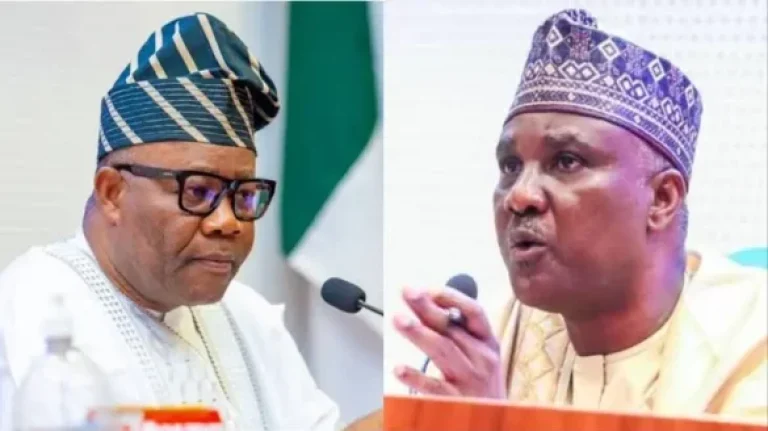
Alleged procurement breaches and missing monies in a National Assembly project highlighted by the Auditor-General are putting Speaker Abbas Tajudeen and Senate President Godswill Akpabio under increasing scrutiny as SERAP’s seven-day ultimatum approaches its expiration.
The National Assembly leadership is reportedly under increasing public pressure due to the scandal over the alleged squandering of ₦18.6 billion set aside for the National Assembly Service Commission (NASC) office-complex project, as reported by this Sunday Independent.
Just last week, SERAP threatened legal action unless Akpabio and Tajudeen made public the specifics of the monies’ use. The deadline for compliance is seven days from now.
In 2020, the NASC paid an undisclosed construction firm over ₦11.6 billion to build a new office complex. In 2023, they paid another ₦6.9 billion for the “conversion of a roof garden to office space,” as stated in the 2022 report of the Office of the Auditor-General of the Federation (AuGF).
Payments were made in breach of Nigeria’s procurement laws, according to the audit probe, as the Bureau of Public Procurement (BPP) did not approve them or conduct competitive bidding.
The absence of a contract agreement, needs assessment, or proof of completion was also noted by the Auditor-General, who expressed concern that the full ₦18.6 billion allocation “may be missing.”
Important details, such as the contractor’s identity, the company’s board of directors and shareholders, and the project’s present condition, were urgently requested by SERAP in its appeal dated October 18, 2025.
The organization threatened to seek legal intervention to force disclosure if the respondent did not comply.
The National Assembly must end its culture of secrecy if it wants other branches of government to be held accountable, according to SERAP, which also stressed the need of openness when it comes to legislative funds in order to win back public trust.
A TERRIBLE AUDIT HISTORY
According to the AuGF’s findings, the NASC distributed the multi-billion-naira contract without recording the procedures for bidding, approvals from tender boards, or due diligence.
The payment schedule was also cause for concern, with over ₦11 billion being transferred in just two years and an additional ₦6.9 billion being paid for a “inflated variation” that did not have any technical or cost rationale, according to auditors.
Even more concerning is the fact that the auditor general found it impossible to verify the project site, which could mean that either work was underpaid or that construction was abandoned.
Based on what we know so far, the original plan for this project, which was mooted in 2018, was to construct a dedicated secretariat for the National Assembly Staff Committee (NASC). This committee is responsible for the hiring, development, and welfare of all employees within the National Assembly bureaucracy.
Despite this, the project has shown up in succeeding budget cycles time and time again with no accompanying tangible development.
The same project keeps getting funded year after year, but the reality is that nothing ever changes, according to a legislative aide familiar with NASC operations who asked to remain anonymous.
“The Assembly’s capital spending now includes it as a recurring decimal.”
A basic question: What happened to the money? This is at the core of the issue.
No one from the Speaker’s office or the Senate President’s has offered any clarification. When our reporter approached officials, they said the matter “concerns the Service Commission and not the Legislature itself” and hence refused to speak.
However, members of the public who keep tabs on the proceedings contend that the officers who preside over the National Assembly should be held to account for this.
Funded by the Assembly’s own budget, the National Assembly Service Commission functions as an agency under the legislature under Nigeria’s budgetary structure. Therefore, the NASC is answerable to the leadership of the National Assembly, which authorizes its spending and oversees it.
Because of their connection, SERAP demands an immediate response from Akpabio and Abbas.
Responsibility must not be overlooked, the group emphasized.
“The money wasn’t meant for a private enterprise; it was for a project in the National Assembly. Legislators should set a good example.
A Demand for Openness
Despite the National Assembly leadership being caught up in this ₦18.6 billion scandal, the Senate Committee on Public Procurement last week reiterated its dedication to openness and compliance in Nigeria’s public contracting procedure.
The purpose of procurement oversight, according to Senator Olajide Ipinsagba (Ondo North), who spoke at a LeadBold Resource Consulting-organized two-day retreat in Abuja, is to guarantee “value for money” and avoid leakages.
“Public procurement is more than just a technical or administrative task; it is the process by which government policies are turned into real services, infrastructure, and development results,” Ipinsagba stated.
Procurement, he said, requires the utmost honesty, efficiency, and responsibility since it comprises a sizable chunk of the country’s budget.
There has been some success in reforming and strengthening compliance mechanisms since the Public Procurement Act of 2007 and the establishment of the Bureau of Public Procurement (BPP), but the senator conceded that further work is required.
He made the point that public procurement is an ongoing process that is always changing and adapting. “The Senate Committee is still dedicated to ensuring that the procurement system is run with honesty and transparency through rigorous legislative oversight, strong policy advocacy, and necessary institutional reforms.”
Transparency in public spending is crucial to achieving President Bola Tinubu’s Renewed Hope Agenda, according to Ipinsagba, who also emphasized the need of aligning with global best practices.
“By bringing our policies in line with global norms and welcoming new ideas, we can make sure that every dollar goes toward stronger educational institutions, safer transportation, better medical care, and a richer country,” he declared.
The moral issue that the Nigerian legislative is currently experiencing is highlighted, according to observers, by the juxtaposition of the Senate’s public demand for transparency with the continuing ₦18.6 billion controversy.
“The optics are terrible,” remarked Dr. Abdul Rahman Bala, a political scientist from the University of Abuja. “The Senate sends mixed signals to Nigerians when it struggles to explain missing billions under its watch, even though it preaches transparency.”
The developing scandal is more than just a challenge to Akpabio’s and Abbas’s reputations; it is a challenge to their political will. How the public feels about the 10th National Assembly’s ability to rein in the economy during this austerity period will depend on their vote.
Groups representing civil society, such as BudgIT and the Transparency Advocates Network, have demanded that all contract documents be made public and that independent engineers be invited to check the project’s performance.
Parliament should act right away, not wait to be sued, BudgIT’s Kolawole Olawoyin stated.
“Transparency should never be forced; it should be a choice.”
Professionals contend that public criticism and internal discipline are necessary for genuine reform. “Autonomy should not mean secrecy,” the Partners for Electoral Reform’s Ezenwa Nwagwu argued.
“The entire idea of checks and balances collapses if the legislature cannot model transparency.”
The gap between words and actions is wider than it has ever been before, with the Senate Committee on Public Procurement calling for reform and SERAP’s ultimatum slipping between the cracks.
The public perception of the 10th Assembly will most likely be shaped by the ₦18.6 billion project, regardless of whether it is an example of overspending, unfinished work, or sheer distraction.
With ₦18.6 billion at stake, the nation’s governance, or lack thereof, is reflected in the mirror in a country still struggling with poverty, unemployment, and public mistrust.
About the Author