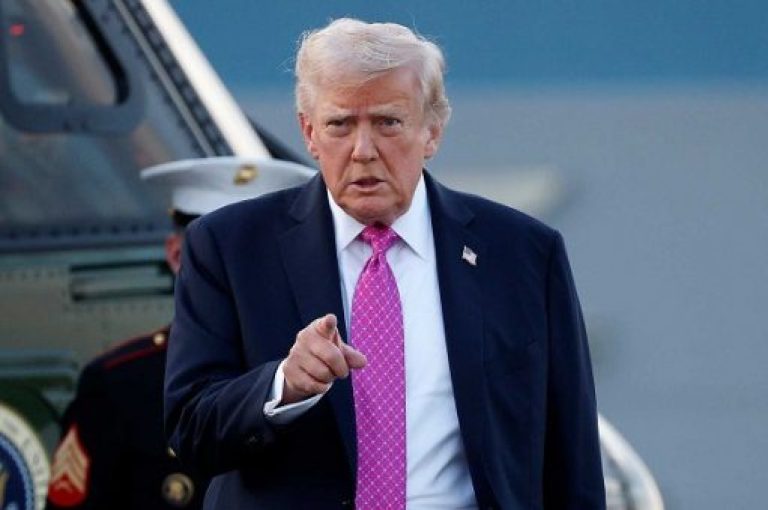


US President Donald Trump (R) and Australia's Prime Minister Anthony Albanese shake hands after signing a document on critical minerals in the Cabinet Room at the White House in Washington, DC, on October 20, 2025. (Photo by SAUL LOEB / AFP)
US President Donald Trump announced yesterday that Australia would receive coveted nuclear-powered attack submarines and signed a rare earth minerals agreement with Prime Minister Anthony Albanese at the White House.
The commitment to Australia, which sees itself as a vital US partner against China, comes after the Trump administration stated earlier this year that it was examining a deal for the submarines inked by former President Joe Biden, says AFP.
“The submarines that we’re starting to build for Australia are really moving along,” Trump told reporters as he met with Albanese in the White House cabinet room.
“We’ve worked long and hard on this, and we’re getting started right now. And it’s moving along pretty quickly and smoothly.”
The two leaders also reached an agreement on crucial minerals and rare earths, which are essential for the technology that powers the global economy.
Albanese has cited Australia’s rich key minerals as a method to weaken China’s grip on world supplies.
Meanwhile, the Australian premier overcame an embarrassing meeting between Trump and Australia’s envoy to Washington, former Prime Minister Kevin Rudd.
Rudd removed a number of scathing social media posts against Trump following the Republican’s presidential triumph last year.
“I do not like you either. I do not. And I probably never will,” Trump said Rudd after a reporter pointed out that the former Prime Minister was in the room and asked if he objected to the comments.
Polls reveal that Australians have a mainly negative opinion of the Trump administration, despite the fact that the country relies on the US to balance China’s growing military influence in the Pacific region.
Rare Earths.
Australia’s government had hoped for Trump’s approval of the 2021 agreement for at least three quiet Virginia-class submarines within 15 years.
The AUKUS submarine agreement between Australia, the United Kingdom, and the United States could cost Australia up to US$235 billion over the next 30 years, according to Canberra.
However, the Trump administration stated in June that AUKUS was being reviewed to ensure that it coincided with his “America First agenda”.
Some domestic critics argued that the United States did not manufacture enough Virginia-class submarines to provide both Australia and its own navy.
The nuclear-powered vessels are essential to Australia’s goal for upgrading its long-range attack capabilities in the Pacific.
Australia had a huge disagreement with France after canceling a multibillion-dollar plan to purchase a fleet of diesel-powered submarines from Paris and instead opting for the AUKUS program.
In the run-up to the White House meetings, Australia pitched itself to Washington as a future provider of vital minerals, such as rare earths, of which China is by far the world’s leading supplier.
Australia has lithium, cobalt, and manganese deposits, as well as rare earth metals that are used in a variety of technologies, including semiconductors, defense gear, electric vehicles, and wind turbines.
Albanese revealed intentions in April to establish a strategic reserve of crucial minerals for “key partners” such as the United States.
The reserve is intended to assist ease China’s stranglehold on global essential minerals output, which it has been accused of using to put pressure on trading partners.
In reaction to China’s recent rare earths export limitations, Trump threatened 100 percent tariffs earlier this month.
However, Trump said Wednesday that he now expects a fair trade deal with China during negotiations with Chinese President Xi Jinping in South Korea.
About the Author