
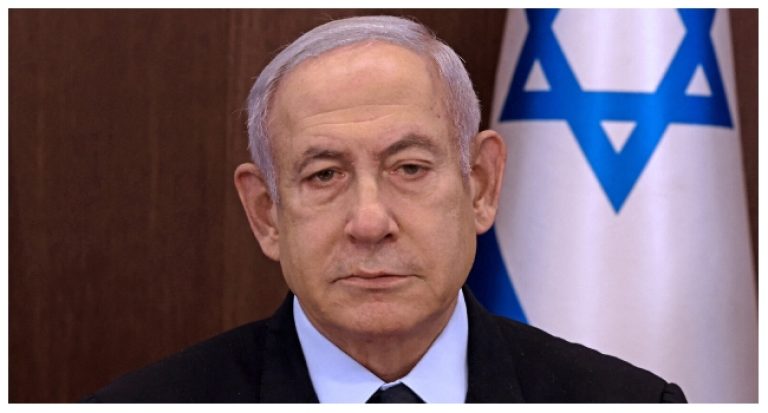
Benjamin Netanyahu, the Prime Minister of Israel, said yesterday that the conflict in Gaza would not end until Hamas was disarmed and the Palestinian region was demilitarized.
According to AFP, his statement came as Hamas’s armed branch, the Ezzedine Al-Qassam Brigades, gave up the bodies of two more captives last night as part of a truce arrangement negotiated by the US.
Late yesterday, the Israeli military reported that a Red Cross team had picked up the bodies of two captives and that the coffins were on their way to its security forces in Gaza.
The deceased captives still in Gaza are a problem that is getting in the way of the first phase of the truce. Israel has said that the reopening of the important Rafah border to the region depends on finding the remains of the prisoners.
Netanyahu said that finishing the second phase of the truce was necessary to end the war.
He added late yesterday that “Phase B also includes taking away Hamas’s weapons and making the Gaza Strip less militarized.”
He said on right-wing Israeli Channel 14, “When that is successfully completed—hopefully in an easy way, but if not, in a hard way—then the war will end.”
Hamas has so far refused to accept the concept, and since the fighting stopped, it has been working to regain control of the Gaza Strip.
The Rafah crossing is blocked.
Hamas has released all 20 living hostages, as well as the bodies of nine Israelis and one Nepalese, as part of the ceasefire deal that US President Donald Trump helped to make.
Israel identified the body as Eliyahu Margalit, who died at the age of 75 in Hamas’s attack on October 7, 2023. The most recent transfer occurred on Friday night.
Since the cease-fire began on October 10, Israel has freed about 2,000 Palestinian prisoners and 135 additional Palestinian bodies in exchange.
Hamas claims it needs time and technical help to find the other bodies, which it says are buried under the rubble in Gaza.
The al-Qassam Brigades announced on Telegram that the two bodies that were returned yesterday “were recovered earlier today.”
Yesterday, Netanyahu intimated that Hamas could have to return all of the hostages’ remains remained in Gaza before the important Rafah gateway to Egypt could reopen.
The Palestinian delegation in Cairo said that the crossing could open as soon as tomorrow, but only for Gazans living in Egypt who wanted to go back to Gaza.
But soon after, Netanyahu’s office announced he had “directed that the Rafah crossing stay closed until further notice.”
It continued, “Its reopening will depend on how well Hamas does its part in returning the hostages and the bodies of the dead and in carrying out the agreed-upon framework.” This was in reference to the ceasefire accord that had been in place for a week.
Hamas said late yesterday that closing the Rafah crossing would entail “significant delays in the retrieval and transfer of remains.”
Making latrines
Tom Fletcher, the UN head of humanitarian relief, was in northern Gaza yesterday. He may have a harder time if the closure is delayed much longer.
“I drove through here seven to eight months ago when most of these buildings were still standing. To see the destruction—this is a huge part of the city, just a wasteland—and it’s just heartbreaking to see,” he told our reporter.
Fletcher remarked that the UN and aid groups have a “huge, huge job” ahead of them.
He stated he had encountered people who were trying to dig latrines in the wreckage of their homes that had been destroyed.
He stated, “They tell me that what they want most of all is dignity.”
“We now have a huge 60-day plan to get a million meals out there every day, start rebuilding the health sector, bring in tents for the winter, and get hundreds of thousands of kids back to school.”
The Rafah crossing hasn’t reopened yet, but every day hundreds of trucks are coming in through Israeli checkpoints and aid is being given out.
“What did they do wrong?”
There has still been some violence, even though the truce is in place.
The civil defense service in Gaza, which is run by Hamas, reported on Saturday that it had found the dead of nine Palestinians—two men, three women, and four children—from the Shaaban family after Israeli troops shot two tank shells at a bus.
It added that two more victims were blasted apart in the explosion and their bodies have not yet been found.
The deceased were laid out in white shrouds at Al-Ahli Hospital in Gaza City while their families mourned.
“My daughter, her kids, and her husband were slaughtered. My son, his kids, and his wife were killed. What was wrong with what they did? Grandmother Umm Mohammed Shaaban asked for it.
The military said it shot at a car that was getting close to the “yellow line,” which is where its troops have to pull back under the conditions of the ceasefire. They didn’t say how many people were hurt.
“The troops fired warning shots at the suspicious vehicle, but it kept getting closer to them in a way that made them feel threatened,” the military claimed.
“The troops shot to kill the threat, as agreed.”
About the Author