
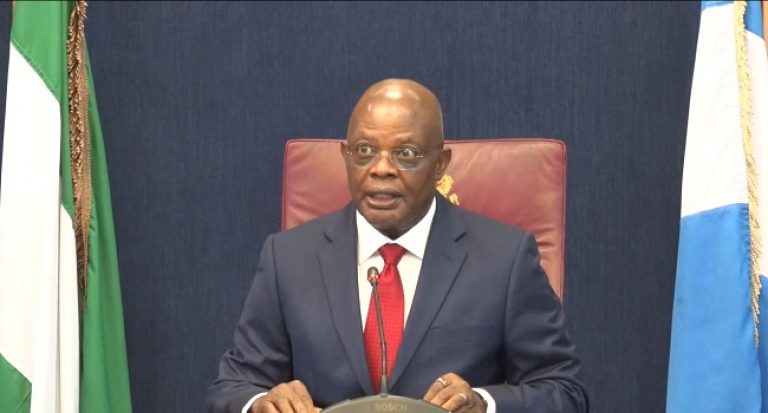
Yesterday, the Federal High Court in Abuja threw out a lawsuit that wanted all of Rivers’ money in the Consolidated Revenue Fund to be returned. The money was released, used, and spent by the Sole Administrator, retired Vice Admiral Ibok-Ete Ibas.
According to NAN, Justice James Omotosho ruled that the Federal High Court (FHC) does not have the authority to decide the issue because it arose from the presidential declaration of a state of emergency.
The judge agreed with the lawyers’ objection to the defendants, which included Kehinde Ogunwumiju, SAN, who represented Ibas in the case.
Justice Omotosho said that only the Supreme Court had the power to decide whether the president’s declaration of an emergency rule was lawful.
“I must not forget to say here that the claimant’s lawyer should do the right research on the case before filing it.”
He must do thorough investigation to find out which court has jurisdiction and who the relevant parties are in the case before he files his action.
“Counsel must be professional in conducting such study instead of disseminating false information or misrepresenting facts on social media and other broadcast platforms.
“This court has a lot of things to deal with, including business, civil, and criminal situations, therefore its time is highly valuable.
“Filing suits that are void ab initio is detrimental to the administration of justice, and the court may, sua sponte, nullify such void suits to conserve its time.”
“I therefore hold that a void process cannot activate the jurisdiction of this court.”
He remarked, “In the end, the subject matter of this suit is not within the jurisdiction of this court, and this court will not take jurisdiction over it.”
The judge also said no to moving the case to the Port Harcourt judicial division, which was one of the plaintiff’s requests for relief.
He said that the request to move the case back to Rivers could not be granted.
He added that a glance at the legislation showed that the court can only move a case to another judicial division, which could be a high court of a state or the High Court of the Federal Capital Territory, Abuja.
“This court has already decided that only the Supreme Court can hear and decide cases related to the Proclamation of State of Emergency. It would be pointless to forward the case to another court that also doesn’t have subject matter jurisdiction.
“This court can’t send this case to the Supreme Court, so the right thing to do is to not send it anywhere else and to throw out the whole process because it doesn’t have jurisdiction.”
He said, “As a result, issue two is decided against the claimant.”
The judge also decided issue three, which questioned the chief judge of the FHC’s ability to move the case to Abuja for a decision.
“Because of this, this court refuses to hear this case, and the originating process filed is declared void because it should not have been filed before this court,” he said.
In the case FHC/PH/CS/43/2025, the Incorporated Trustees of Rivsbridge Peace Initiative sued President Bola Tinubu as the first defendant.
The group also identified the Federal Republic of Nigeria, the Attorney General of the Federation, the Accountant General of the Federation (AG-F), the Central Bank of Nigeria (CBN), and Ibas as the second through sixth defendants.
The group has questions about Ibas’ appointment.
It also asked for a mandatory injunction that would require the 1st, 2nd, 3rd, 4th, 5th, and 6th defendants to immediately return, refund, or pay back any money in the Consolidated Revenue Fund that belonged to Rivers State and was released, appropriated, or spent after March 18, when the president declared a state of emergency, among other things.
It said that the action went against the clear terms of Section 120,121,287(1) of the 1999 Constitution (as amended) and the current Order(s) of the Supreme Court in Rivers State House of Assembly versus Govt of Rivers State (2025).
Justice Omotosho also threw out the second case, FHC/PH/CS/46/2025, which questioned Ibas’s ability to appoint single administrators for the state’s 23 local government areas of Rivers.
The plaintiffs’ lawsuit only named Ibas as the defendant.
The judge agreed with lawyer Ogunwumiju’s first objection to Ibas, saying that the plaintiffs did not have the legal authority to launch the complaint.
He added that the plaintiffs were not one of the suspended LGA chairmen and that they could not have sued the Federal Government or Ibas over a disagreement that supposedly affects the people of Rivers.
“The applicants are just people who happen to live in Rivers State.
This case is completely invalid and has no legs to stand on until the Sole Administrator gives their assent and it is filed with the original process.
He remarked, “The applicants do not have locus standi, so this action will be dismissed and sent to a higher court for a decision. This court does not have that power.”
He said again that the court did not have the power to hear the matter.
“In the end, the applicants’ case is sure to fail because this court can’t take it up because the applicants don’t have standing or jurisdiction over the subject matter.”
Justice Omotosho said, “This action is therefore dismissed for being void.”
Earlier reports said that the judge threw out a case that wanted an order saying that President Tinubu’s suspension of Gov. Siminalayi Fubara of Rivers was unlawful.
Belema Briggs, Princess Wai-Ogosu, I. Acho, Emmanuel Mark, and Hadassa Ada filed the complaint, which was given the number FHC/PH/CS/51/2025. They said they were suing for themselves and the people of Rivers State.
They named the President of Nigeria, the Attorney General of the Federation, Ibas, and the Nigerian Navy as defendants.
The plaintiffs questioned the emergency declaration, the suspension of elected officials (including Gov. Fubara), and the appointment of a single administrator. They also asked the court to annul the president’s actions.
About the Author