

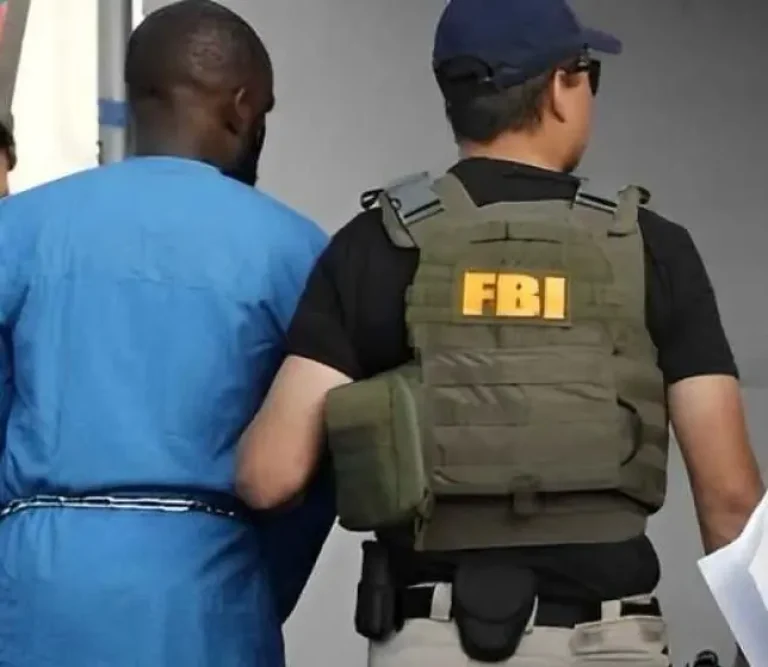
A US Department of Justice official has detailed how a Nigerian man named Farouk Adekunle Adepoju, who lives in the UK, used phony emails to steal $235,000 (N363 million) from a US institution.
According to US prosecutors, Adepoju hacked into the email system of a Pennsylvania construction company that the university hired, then made bogus accounts to pretend to be employees and steal funds, AFP says.
The US Department of Justice announced that Adepoju was detained on September 15, 2025, and is now waiting to be sent to the Western District of Pennsylvania to face seven charges.
According to court filings, Adepoju accessed the company’s computer system from a distance between March and April 2023, changed the restrictions for email, and set up a fake domain. After that, he sent bogus payment instructions to the institution using the fake emails.
The university thought the emails were real, so they changed the construction company’s payment information to an account held by Adepoju. This resulted to a transfer of roughly $235,266 (N363 million).
Troy Rivetti, the Acting US Attorney, said that the money has not been found.
Rivetti stated, “Adepoju is accused of using advanced cyber tools to break into a business’s accounts and steal money from one of our region’s universities.”
“Even though Adepoju was on the other side of the world, the Federal Bureau of Investigation could still look into him. His arrest in the UK shows how committed our district is to finding and punishing cybercriminals all across the world with the help of our law enforcement partners, both locally and abroad.
Kevin Rojek, the FBI’s Special Agent in Charge in Pittsburgh, said that the US government won’t let this kind of fraud happen to the American people, no matter where it happens.
“Criminals who think they can steal money from the American people by reaching out to the US from other countries need to know that the FBI and our allies will not allow you get away with it.
“We will find you and make you pay for what you’ve done, no matter where you are.” “Email compromise schemes are not victimless crimes; they are one of the costliest threats large and small businesses, universities, and organizations face today,” Rojek added.
There are six counts of wire fraud and one count of computer fraud against Adepoju. The most time someone can get for wire fraud is 20 years, while the most time someone can get for computer fraud is 5 years.
The FBI’s Pittsburgh Field Office spearheaded the investigation. The case is being prosecuted by Assistant US Attorney Mark V. Gurzo with help from the Department of Justice’s Office of International Affairs.
Authorities noted that an indictment is simply an accusation and that Adepoju is innocent until proven guilty.
About the Author