
Anthropic, an American business that makes artificial intelligence, became involved in the US-China battle earlier this month. It said that enterprises that were more than 50% owned by Chinese businesses couldn’t use its AI services. This was a double whammy: China’s access to American technology hit another snag, and the global business community was once again told to say no to Chinese investment.
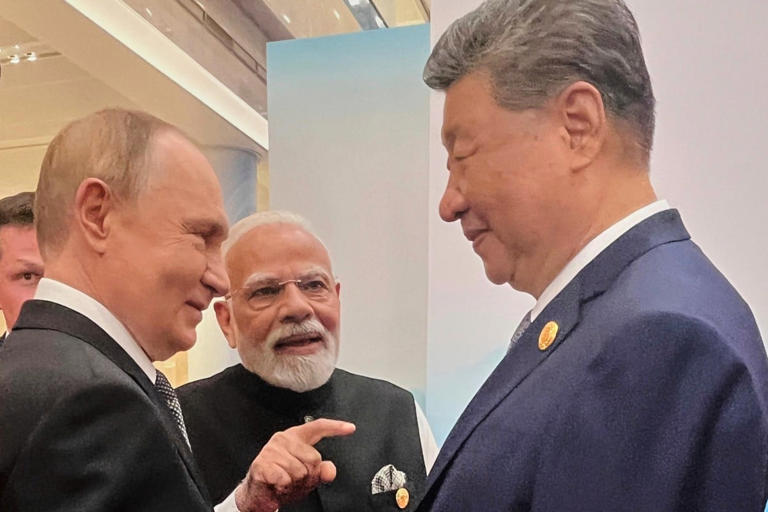
Anthropic’s move would have shocked China just a few months ago. But the recent Shanghai Cooperation Organization (SCO) conference in Tianjin and military parade in Beijing have given China fresh energy, and it seems like nothing can stop it as the geopolitical winds turn eastward.
Kenya is de-dollarizing in Africa by changing some of its debt from US dollars to yuan. Slovakia is getting Chinese rare earths in Europe, even though the European Union wants to cut down on imports. And in Asia, after over 20 years of talks, the Power of Siberia 2 pipeline is said to be moving forward, preparing to turn European gas fields into Chinese ones.
The “holistic shifts” that are going on around all of this include the US handing Beijing a “hall pass” over the war in Ukraine and a possible reset between China and India.
China is winning big all throughout Eurasia. But this isn’t about countries looking for a way to avoid US President Donald Trump’s “America first” trade strategy anymore. There are no orders in the globe right now, which hasn’t happened since the Cold War. It might be time for China to change the globe.
What will Beijing do? Stable trade and growth are what we need right now, and that includes China. The rate of increase in its exports has slowed to a six-month low, even as it shifts trade to places like the Association of Southeast Asian Nations, where exports were up 22.5% year on year last month, or Africa, where it has a US$60 billion trade surplus this year. Emerging markets still can’t match the West’s buying power.
China can either be the architect and come up with a new plan for globalization, or it may be the firefighter, putting out fires in other countries and protecting the institutions that America helped establish. This would be a bizarre position. There are many challenges that China will have to face no matter which way it goes.
Who can China count on to take advantage of the situation? For example, there are a lot of rivalries in the SCO. Key players like India and Pakistan are still acting like they’re at war, which makes it impossible to integrate or come up with new ideas.
Azerbaijan and Armenia, two possible members, recently made a strategic deal with China. They also just gave the US control of the so-called Zangezur Corridor, which changes how China can “leverage” these countries.
Can China count on its old friends? For example, the relationship between China and Pakistan is in uncharted territory now that Islamabad has turned to the Asian Development Bank for a $2 billion loan to help pay for its biggest Belt and Road Initiative project, the China-Pakistan Economic Corridor. This is because China is hesitant to put more money into the project.
Even Russia, China’s closest friend, is getting ready a rare earth blueprint for November. This could mean that Moscow will soon join a geopolitical arena that is mostly controlled by Beijing. Who will Russia sell them to?
The truth is that China’s next big move rests on people it can’t entirely control. If Beijing fails to deliver, numerous governments may reevaluate the extent to which their futures should be oriented towards China. But this isn’t just about changing trade laws; it’s also about keeping countries safe that depend on China for their future.
China couldn’t stay out of the fight when the US goes up against Venezuela, which exports 90% of its oil to China and is one of the few countries that can be counted on in any situation. If things go wrong in both Iran and Venezuela and China doesn’t do anything, it will be hard for China to compete with the US.
China has some things it could try out. One idea is to bring up the “Venezuela question” in US trade talks, linking access to rare earths to how well one of Beijing’s closest partners is treated. Another option would be to cut off supplies of important minerals to countries that don’t follow what China terms “common security.”
Washington would be in a tough spot because it would have to pick between protecting its economy and supply systems or going after geopolitical aims and social issues like fighting narcotics.
A world with no orders is a world that has gone crazy. Brazil asked for an emergency Brics meeting last month to deal with the trade problems. Like India, the US has put a 50% tax on goods coming from Brazil. But even though people used language like “tariff blackmail,” not much more happened.
Things are not clear-cut for China or the rest of the globe. No matter what Beijing does, the US is dancing to a new beat. Some people could think that neither country has everything they need.
For China, it’s all about speed, substance, and safety. Beijing needs to act quickly, offer meaningful solutions, and protect those who support it. At the heart of it all is a basic question: where is China taking these nations?
Tariffs are only a short-term problem. A trade war or an actual war will eventually be replaced by something else that causes trouble. At certain times, China can’t be lost and confused like the rest of the world. Beijing needs to remake itself before it can redefine the world. Can China be the one to keep things in order in the world?
About the Author