
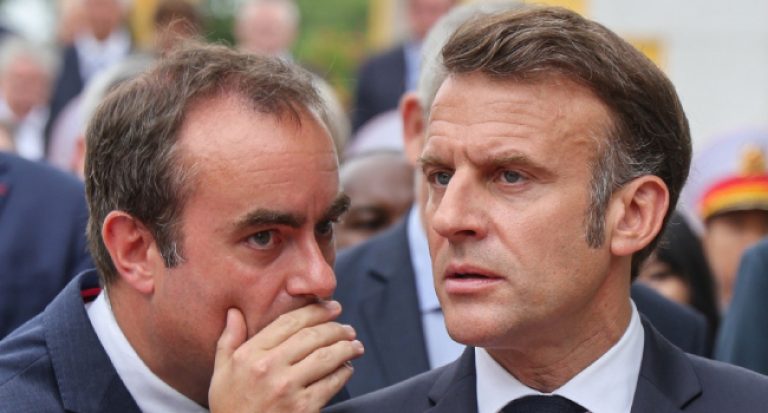
French President Emmanuel Macron nominated Sebastien Lecornu, his close friend and defense minister, as the next prime minister yesterday. This was done to help end a political crisis that was getting worse and protests were expected in the following few days.
Macron has chosen Lecornu, 39, to be the seventh prime minister of his term instead of trying to make the government more appealing to a wider range of people. This is according to AFP.
The Elysee Palace said that Macron instructed Lecornu to “talk to the political parties represented in parliament about adopting a budget for the country and making the agreements necessary for the decisions of the next few months.”
Bayrou, who was in power for only nine months, gave his resignation to Macron earlier yesterday after the French parliament voted to remove the administration.
The official transfer of power from Bayrou to Lecornu is set to happen on Wednesday at noon.
In the past, the French president has been very slow to choose a new prime minister. But this time he has done it in less than a day because of the possibility of political and economic turmoil.
“The Liberation daily added, “Emmanuel Macron is now in the front line to find a solution to the political crisis.”
France’s borrowing costs, which show how confident investors are, went up a little more than Italy’s yesterday. Italy has been one of Europe’s worst debtors for a long time.
“The president is sure that (under Lecornu) an agreement between the political parties is possible that respects everyone’s beliefs,” stated the Elysee.
“Vulnerable”
Bayrou surprised even his friends by seeking a vote of confidence to overcome a long stalemate over his austerity budget, which called for almost 44 billion euros ($52 billion) in reductions to help France pay down its debt.
In the end, 364 members of the National Assembly said they didn’t trust the government, while only 194 said they did.
Since Macron became president in 2017, Bayrou has been the sixth prime minister, and since 2022, he has been the fifth.
A no-confidence vote in December brought down his predecessor, Michel Barnier.
The problem started with the summer 2024 elections, which left the parliament with no clear majority.
The daily Le Monde wrote, “Emmanuel Macron, a weak president.”
Macron has been working hard to halt Russia’s war on Ukraine through diplomacy throughout the world. He had to make one of the most important decisions of his presidency when he chose who to nominate as prime minister.
Lecornu has been in his job for more than three years, which is most of the time that Russia has been invading Ukraine, and he is a strong supporter of Kyiv.
People regard him as a quiet but very good operator who, most importantly for Macron, does not want to be president himself.
People thought Lecornu would get the post in December, but in the end, Bayrou forced the president to give him a chance.
“Has the qualities”
France is not only going through a political crisis, but also a social one.
“Block Everything,” a left-wing group, is calling for a day of action on Wednesday, and trade unions are telling workers to go on strike on September 18.
“I hope we can come to an agreement. Interior Minister Bruno Retailleau, who is also the head of the biggest right-wing party, The Republicans Party, said, “I think there is a chance of building a project that meets what I call the national majority.”
The 2027 presidential race is still wide open, but experts say the French extreme right has its best chance of winning ever. In 2027, Macron can’t run for a third term.
Marine Le Pen, a three-time presidential candidate for the far-right National Rally (RN), is hoping for a good conclusion from an appeal hearing early next year. She was found guilty of a European Parliament phony jobs scam that kept her from running for office.
She called Lecornu’s appointment the “last shot of Macronism.”
The Socialist Party, which wanted to be the next prime minister, criticized Macron for not including them and said the president had risked making people angry and causing the government to remain stuck.
But Edouard Philippe, a former prime minister from the center-right, was more hopeful. He told TF1 television that Lecornu “has the qualities” to “talk” and “reach an agreement” with the other parties.
About the Author