
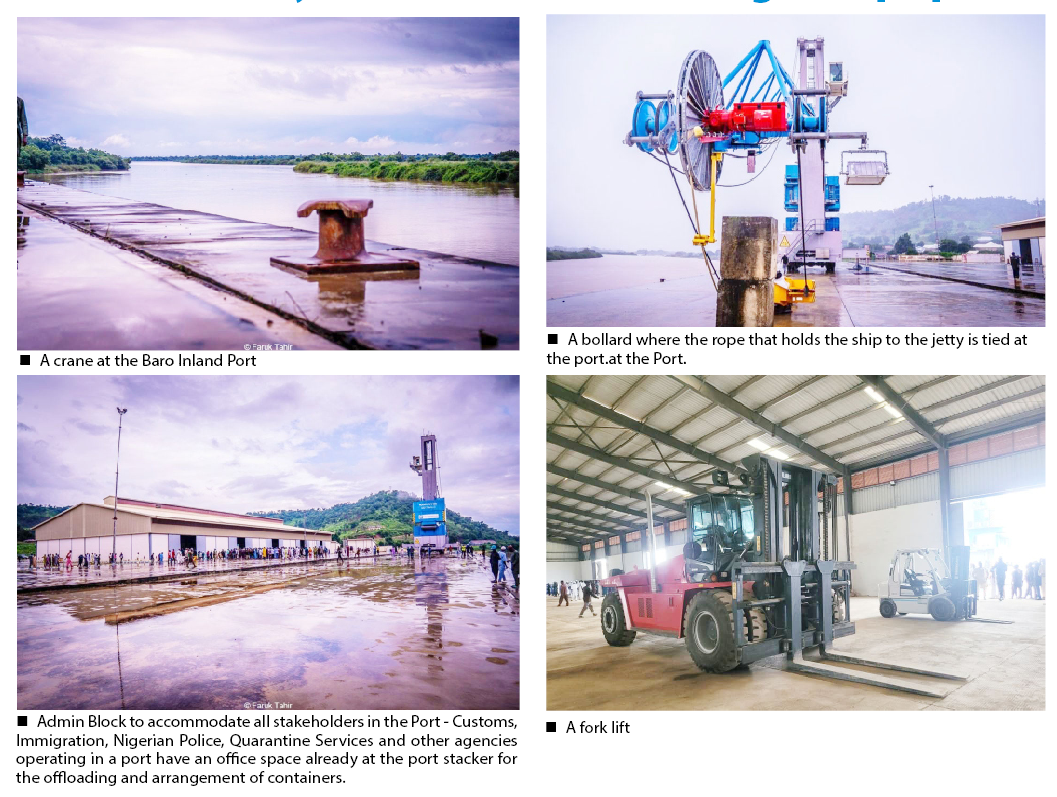
The House of Representatives Ad-hoc Committee on the Rehabilitation and Operationalisation of Baro Port says that the main problems that have stopped the multi-billion-naira inland port in Niger State from working are that key government agencies don’t work together and that there aren’t enough infrastructure.
Hon. Saidu Musa Abdullahi, the committee’s chairman, said this when he and other members of the committee visited the Media Trust Group (MTG) headquarters in Abuja. MTG publishes Daily Trust and Aminiya and owns Trust TV, Trust Radio, and Digital Trust.
He said the purpose of the visit was to ask Media Trust Group to help with campaigning and getting the people involved in bringing the long-abandoned multi-billion-naira inland port in Niger State fully operational.
“Port left empty six years after it was built”
Six years after former President Muhammadu Buhari opened the project, it still hasn’t started working, which has stakeholders worried.
One of our reporters went to the facility in 2024 when nothing was going on at the Port. According to Daily Trust, no cargo has been moved and no ships have docked.
“Our hopes for development are getting lower every day because nothing has happened at the port since it opened,” Ndagana Mohammed, a school teacher from Baro, said our reporter at the time.
Mohammed added, “Our environment, including farmland, was destroyed during construction.” We gave up everything to make sure that development came to our neighborhood, but it looks like our efforts were for nothing. We don’t really know what’s going on.
“The route from Agaie to Baro through Katcha has been slow for more than five years, which has hurt our economic activities including fishing and farming.
“We are, however, hopeful that the port will take off under the current government led by Tinubu.”
Aside from the problem with dredging, the Baro Port has had trouble getting started because of bad roads.
It was noted that getting to the facility has been a significant pain because the roads and railways that should help it run are in terrible shape.
The Baro/Katcha/Agaie Road, which is 55 kilometers long, and the Baro/Muye Road, which connects Gegu to the Abuja/Lokoja expressway, are the two main roads that go to the huge neighborhood. Both are in terrible shape.
People say that the federal government gave the contract for the Baro/Katcha/Agaie axis in 2009 but took it back in 2012 because the contractor didn’t finish the job on time.
The reps committee is working harder to put things into action.
The Reps Committee Chairman made it clear during the meeting with the MTG that getting everyone on the same page would be the key to the project’s success or failure.
“Our job is to talk about the challenges and opportunities of Baro Inland port and show how stakeholders are involved.” And we can’t accomplish that without the media being involved.
“You are termed the fourth estate of the realm, and not simply for saying so. It’s because of the worth that comes from this side of the line. Our job is hard, but it may also be extremely easy, depending on how much agreement we can reach before we really get the stakeholders involved. Based on our work plan, we’ve had interactive sessions with important stakeholders, especially those in charge, he stated.
Abdullahi claimed that Baro Port, which was opened in 2019 by the late former President Muhammadu Buhari and already had advanced cargo-handling facilities, had been sitting empty because ministries and agencies weren’t working together to get it operational.
He stated it was not okay for a port that was finished and supposedly opened to yet be dead six years later.
“Why the port is still empty”
“Baro Port has all the right equipment set up and ready to go, but it’s not being used because the key players aren’t working together.” Instead of working together, ministries and agencies have been working in separate groups. He stated, “That has to change, and the media is a big part of making that happen.”
The lawmaker said that his committee had worked with important groups like the Ministry of Blue Economy, the Ministry of Transport, the Ministry of Works, the Nigerian Railway Corporation, the National Inland Waterways Authority, the Bureau for Public Enterprises, and the Nigerian Sovereign Investment Authority to stop the cycle of fragmentation and get Baro Port back up and running.
“We are putting all of them under one roof for the first time. One of the biggest challenges that has hurt Baro is that people don’t work together. “But now we are getting everyone to work together toward a common goal,” he remarked.
Abdullahi also said that the problem was getting worse because of infrastructure problems. For example, the dredging of the River Niger, the rail link to Minna, and the access roads to the Baro Port were either not finished or were stopped because of a lack of money.
“Contracts have been sent out for the rail and the three access roads, but not much has happened because there isn’t enough money. This is why we claim that government money alone can’t make Baro work. We need to get the private sector involved. He remarked, “Anyone who puts money into Baro will make money because the project is viable.”
He said that the team has been traveling over the country to get key stakeholders on board with the plan to reopen the Baro Port.
He said that past Heads of State, Generals Abdulsalami Abubakar and Ibrahim Babangida, as well as traditional leaders like the Etsu Nupe, Alhaji Yahaya Abubakar, and Emir of Agaie, Alhaji Yusuf Nuhu, had all supported the initiative and said that Baro must not fail.
He says that making the port work will unlock Niger State’s huge agricultural potential, promote agro-processing, create jobs, increase exports, and bring in new investments for Nigeria as a whole, not just the state.
He remarked, “We’re not just talking about moving rice and yams; we want to move finished agricultural goods that will make people rich and give them jobs.”
Abdullahi went on to say that Baro should be a model for bringing back other national assets that have been left behind or not used enough, like Ajaokuta Steel.
The congressman said that problems with funding shouldn’t stop the port from working, and that private investors may be persuaded to get the project going because it is feasible.
“But in today’s world, not having enough money, especially from the government, shouldn’t stop any significant infrastructure projects, especially those that are directly related to the country’s economic growth.
“There is money accessible all over the world, but it depends on how you write your report and how likely your project is to get a loan. And it should be clear that this initiative is possible and can make money. Anyone who deposits their money there is almost certain to get a very excellent return over time.
“So, knowing this, we chose to come here. We’re also going to talk to other important people, notably those in business, because we don’t want to rely on government support alone. We want to get the commercial sector interested in this. We have tried out several models in different parts of the world.
“I wouldn’t judge any minister based just on how much money they had in their budget if I were president. I would inquire what steps you have taken to get more money. It is not okay that a port that was built in 2019 is still not being used. “We need to get our money’s worth,” he said.
Malam Ahmed Shekarau, the Group Chief Executive Officer (GCEO) of Media Trust Group, promised the organization will help and called Baro a very important project for the North and Nigeria as a whole.
“Most of our audience is in northern Nigeria, and we know how hard it is to be unemployed and underdeveloped here. Once it is working, Baro Port will be a tremendous help for the whole country, not just the North. “We are fully on board, and we will support this project through advocacy, reporting, and public education,” Shekarau said.
He also said that MTG’s move to a fully integrated digital-first platform would help get the committee’s message out to investors in both the US and around the world.
“The chances at Baro are endless. Some of the investors you want to get are not from Nigeria, therefore it’s important to be able to talk to them. We will work with you to make sure that Baro is not just up and running, but also a success story for Nigeria.
“We are a media company that works across Africa. Of course, we come from very humble beginnings, but now we are a multimedia firm. But as we frequently say in politics, politics is local. The area we serve is Northern Nigeria. And we know very well how hard it is to find work all around the country. But we care more about the people of Northern Nigeria because 80% of our audience lives here in the North. So, this is certainly going to be a big help for the folks who live in this area.
“And of course, as you mentioned, to the whole country. So, we’re all for it. We will help you in every way we can. Of course, as an independent business, we’ll provide a real offer that will be drastically discounted. As you indicated before we started talking formally, you know that we are always willing to provide you discounts. We are pretty open-minded when we talk about things. He said, “We go into whatever we think will be good for Nigerian society.”
The group is planning to conduct a big meeting with important players shortly. The goal is to come up with a bankable framework that would bring in private investment for Baro Port and other projects like it.
On Wednesday, May 21, 2025, the House of Representatives decided to form an ad-hoc committee to lead the work to fix up and make the Baro Inland Port in Niger State usable again.
The resolution came after a motion that was supported by former deputy speaker Hon. Ahmed Idris Wase (Plateau, APC) and ten other people.
Wase moved the motion and said he was worried that Baro Port, which was built in 2019 under President Muhammadu Buhari, is still not working because the roads are bad, there is no rail connection, and there is no effective operational framework.
He added that Lord Frederick Lugard built the Baro Port in 1908. It was Nigeria’s first colonial interior river port, and it was connected to Kano by rail in 1911.
Wase claimed that Baro Port was an important center for trade and logistics. It made it easier for goods to flow from the northern region to the Baro–Onitsha–Apapa corridor and back again. This helped the economy, created jobs, and brought the country together.
The committee is supposed to talk about the Baro Inland Port’s problems and opportunities, among other things, and write a policy paper to help the port get up and running.
About the Author